
Every minute a lead waits unassigned reduces the chance it converts.
Most businesses don’t struggle with lead assignment because of volume.
They struggle because assignment is treated as a manual decision instead of a system process.
Automatic lead assignment is not just routing. It is a controlled system that decides who gets what lead, when, and why—based on predefined logic.
For a broader system view, explore our guides, solutions, services, or browse all blogs.
Key takeaways
- Manual lead assignment creates delays and inconsistency
- Automation enforces speed, fairness, and logic
- Assignment systems depend on clean data and defined rules
- Most failures come from missing logic—not missing tools
The problem with manual lead assignment
Manual assignment depends on availability, attention, and judgment.
Leads sit in inboxes, CRMs, or spreadsheets waiting to be noticed.
This introduces delay at the most time-sensitive point in the pipeline.
This delay is typically caused by bottlenecks in manual assignment, as illustrated below.

According to Harvard Business Review, response time has a direct impact on conversion rates. Research shows companies responding within one hour are nearly seven times more likely to qualify leads, while delays beyond 24 hours make qualification over 60 times less likely (Harvard Business Review — The Short Life of Online Sales Leads).
Data / Evidence
Speed-to-lead is a measurable competitive factor.
A study conducted with MIT and InsideSales.com found that the odds of qualifying a lead drop 21 times when response is delayed from 5 minutes to 30 minutes, and the odds of making contact drop 100 times over the same window (MIT Lead Response Management Study).
Assignment delay is often the hidden cause behind slow response—not lack of effort. Research shows that when leads are assigned to unavailable reps, response times shift from minutes to hours, while automated assignment can improve response time and conversion by up to 87% (DigitalLitmus — Lead Assignment Research).
Where it breaks
Lead assignment systems fail in four predictable areas.
1. No assignment rules
Leads are distributed randomly or manually, often based on whoever notices them first.
This creates inconsistent ownership and delays at the most critical point in the pipeline.
2. Incomplete data
Leads arrive without key fields like location, source, or intent.
Without structured data, assignment rules cannot execute reliably.
3. CRM dependency gaps
The CRM captures leads but does not assign them automatically.
This creates a gap between intake and action where leads sit idle.
4. Human bottlenecks
A manager or rep becomes responsible for assigning leads.
This introduces delay, inconsistency, and scaling limitations.
Symptoms
- Leads sitting unassigned for hours or days
- Multiple reps contacting the same lead
- Some reps overloaded while others idle
- Inconsistent response times across the team
If you are also experiencing delayed responses, see why leads are not being followed up.
System effects
Assignment failure propagates across the entire revenue system.
Routing breaks. Follow-up delays. Pipeline data becomes unreliable.
According to Gartner, poor data quality and misaligned processes cost organizations an average of $12.9 million annually and lead to missed growth opportunities and reduced ROI (Gartner — Data Quality).
Further analysis shows that nearly 60% of organizations do not measure the financial impact of poor-quality data, leaving revenue leakage and process inefficiencies unaddressed (Gartner — Smarter With Gartner).
This often starts with unclear routing logic, which you can explore further in this guide on automating lead routing.
Why this problem gets worse at scale
As lead volume increases, manual assignment does not scale linearly.
Delays compound, ownership becomes unclear, and response time variability increases.
This turns a minor inefficiency into a systemic revenue leak.
At scale, systems must distribute leads instantly across teams, as shown below.

Because qualification odds drop significantly after minutes of delay, assignment systems must trigger instantly and include fallback rules within short time windows.
As systems grow, routing complexity also increases. If your issue is distribution logic complexity → automate lead routing.
Root cause
The core issue is not lack of tools.
It is lack of defined assignment logic.
Most businesses cannot clearly define:
- Who should own this lead
- Which rule takes priority when multiple apply
- What happens when assignment fails
Without this clarity, automation simply scales the problem.
Assignment logic breakdown
Automatic lead assignment works through structured decision layers.
Assignment is one part of lead routing, but focuses specifically on ownership distribution rather than full routing logic.
1. Trigger
A lead enters the system (form, ad, CRM entry).
2. Qualification filter
The system checks basic criteria before assignment.
If your issue is qualification accuracy → automate lead qualification.
3. Assignment decision logic

As shown above, assignment decisions are not linear—they depend on layered rules working together.
This is where assignment actually happens—when the system determines which specific rep receives the lead.
This decision is based on layered rules, not a single condition.
- Primary rule (e.g., territory ownership)
- Secondary rule (e.g., round-robin within a segment)
- Override rule (e.g., priority leads or availability status)
For example, a lead from a Facebook ad in Manila may first be assigned by location, then distributed among available reps in that region, and reassigned if no response occurs within minutes.
Without a defined hierarchy, systems produce conflicts such as duplicate assignments, uneven distribution, or delayed ownership.
4. Assignment method
The method determines how leads are distributed once rules are applied.
Each method solves a different operational problem.
- Round-robin: Ensures equal distribution, but fails when reps have different capacities or performance levels.
- Territory-based: Matches leads to regions, but can overload high-demand territories.
- Priority-based: Routes high-value leads first, but can delay or neglect lower-tier leads.
- Availability-based: Assigns to active reps, but requires real-time tracking and strong fallback logic.
Most systems combine these methods.
Example hierarchy:
- 1. Assign by territory (ownership)
- 2. Distribute via round-robin (fairness)
- 3. Override with availability (speed)
This layered approach prevents conflicts and ensures both fairness and responsiveness.
5. Action trigger
The assigned rep is notified and follow-up begins immediately.
Solution
Automatic lead assignment requires more than tools. It requires defined logic.
Effective systems define assignment across three operational layers:
- Segmentation: Define who should handle each type of lead (e.g., territory, product, deal size)
- Prioritization: Establish which rules take precedence when multiple conditions apply
- Fallback logic: Define what happens when assignment fails or no rep is available
To prevent leads from being lost, systems must include fallback paths, as illustrated below.
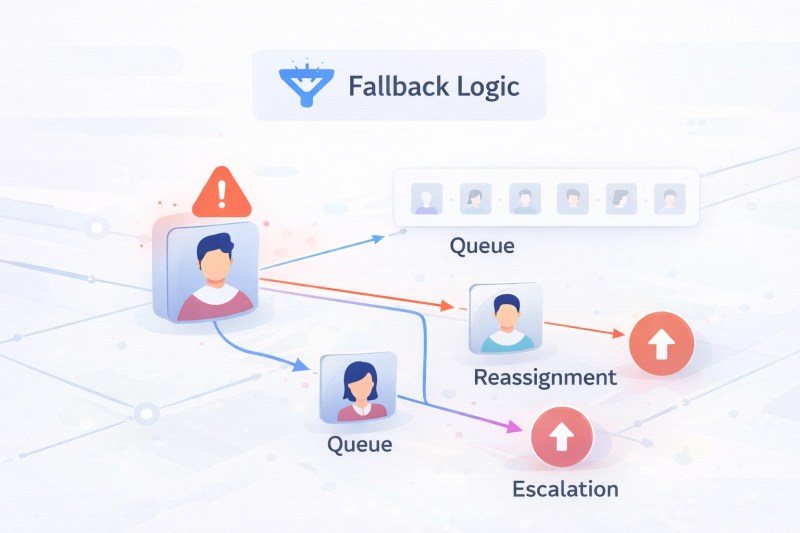
For example, a system may assign leads by territory, distribute them via round-robin within that territory, and reassign them if no response occurs within a defined time window.
This is what turns assignment from a manual task into a reliable system.
This is typically where teams implement CRM-level automation to ensure these rules execute consistently.
If your issue is CRM-level execution → automate CRM lead assignment.
For full system context, see lead management automation guide.
Mid CTA: If your assignment process is inconsistent or delayed, consider implementing CRM automation services to enforce structured routing.
Before vs After

This contrast highlights how automation removes delay and enforces immediate response.
| Manual Assignment | Automated Assignment |
|---|---|
| Leads wait for review | Leads assigned instantly |
| Inconsistent distribution | Rule-based fairness |
| Human dependency | System-driven execution |
| Delayed response | Immediate follow-up |
FAQ
What is automatic lead assignment?
It is the process of assigning leads to sales reps using predefined rules and automation.
Do I need a CRM?
Yes. A CRM provides the structure needed to store lead data and execute assignment rules reliably. Without it, automation cannot consistently trigger or track ownership.
Can this work without lead scoring?
Yes, but performance improves when combined with scoring because prioritization becomes more accurate.
What happens if no rep is available to take a lead?
A properly designed system includes fallback logic triggered by time or inactivity.
For example:
- If no response within 5–10 minutes → reassign to another rep
- If no rep is available → send to a shared queue
- If still unclaimed → escalate to a manager or next available team
Without fallback rules, leads remain unassigned or delayed, directly impacting conversion.
If your problem is prioritization → lead qualification automation explained.
Conclusion
Lead assignment is not a task.
It is a system control point.
When it fails, everything downstream becomes slower and less reliable.
Automation replaces delay with logic.
Next step
If your current system relies on manual assignment or inconsistent routing, the issue is structural.
Start by defining your assignment logic before implementing tools.
Get a free business process audit to identify where your lead assignment system is breaking.