
Most businesses think lead routing is just assigning leads to sales reps. It’s not.
In short: Lead routing determines who responds to leads, how fast they respond, and whether those leads convert. Manual routing creates delays, while automated systems assign leads instantly based on rules and data.
Lead routing determines who responds, how fast they respond, and whether the lead converts at all. When routing fails, leads don’t just sit—they decay. Interest drops, competitors win, and revenue disappears silently.
Most businesses don’t actually have a lead routing problem—they have a response orchestration problem. Routing is simply where the breakdown becomes visible.
If you’re new to how this fits into the bigger system, explore automation guides or browse more automation blogs to understand the full picture.
Key takeaways
- Lead routing determines speed, ownership, and conversion outcomes
- Manual routing creates delays, gaps, and lost opportunities
- Routing failures are usually system problems, not people problems
- Automated routing assigns leads instantly based on rules and data
- Fixing routing improves response time, pipeline flow, and revenue predictability
What is lead routing?
Lead routing is the process of assigning incoming leads to the right person, team, or system based on predefined rules such as geography, lead source, deal size, or availability.
In modern systems, routing is automated through CRM workflows and integrations rather than handled manually.
To understand how routing fits into a broader system, see this lead management automation guide.
Why lead routing matters more than you think
Speed is the biggest factor in lead conversion. The faster a lead is contacted, the higher the chance of closing.
Research shows that responding within minutes significantly increases qualification rates. The Lead Response Management Study found that the odds of qualifying a lead drop dramatically when response time increases—even from 5 minutes to 30 minutes.
But speed alone is not enough. A fast response from the wrong person still kills the deal, which is why routing accuracy matters as much as speed.
Companies that optimize routing and response workflows consistently outperform those relying on manual assignment. According to McKinsey & Company, sales automation can improve efficiency by 10–15% and drive revenue growth of up to 10%—a meaningful gain for teams struggling with slow response times and inconsistent pipeline flow.
Where lead routing actually breaks
Most routing systems don’t fail visibly—they break quietly inside operations.
In most audits we run, routing delays are one of the first hidden bottlenecks we uncover—especially in teams relying on manual assignment or loosely defined ownership.
Data problems: Leads arrive with missing or incorrect data, making routing rules unreliable.
Process gaps: Leads sit unassigned because ownership is unclear.
System limitations: CRMs lack automation logic, forcing manual handling.
Human delays: Sales teams prioritize existing deals over new leads.
No prioritization: High-value leads are treated the same as low-quality ones.
Example: A SaaS company generating 50–100 inbound leads daily often relies on manual assignment inside their CRM.
In practice, this creates a 30–60 minute delay before a lead is even owned—during which competitors are already responding.
By the time a rep reaches out, the lead has either gone cold or chosen another vendor.
If your issue is slow responses after routing → automate lead response workflows.
The 5-minute lead routing test
If a new lead comes in right now:
- Is it assigned instantly?
- Does someone respond within 5 minutes?
- Is it routed to the right person?
If not, your routing system is already leaking revenue.
Signs your lead routing is broken
Most teams don’t notice routing problems directly—they see the symptoms.
Leads take 30–60 minutes to get assigned, or sit untouched entirely. Multiple reps may contact the same lead, while others receive no follow-up at all.
High-intent leads get delayed, low-quality leads consume time, and pipeline performance becomes inconsistent.
If you’re experiencing pipeline inconsistencies, read common CRM pipeline problems.
Hidden system effects of poor routing
Routing failures don’t just affect speed—they damage the entire revenue system.
Conversion loss: Leads disengage before sales begins.
Team inefficiency: Sales reps waste time on the wrong opportunities.
Data distortion: Reporting becomes unreliable due to unclear ownership.
Customer experience damage: Leads receive delayed or irrelevant responses.
According to HubSpot, poor lead management leads to missed revenue targets, higher acquisition costs, and inconsistent performance.

Why most lead routing setups fail
Most businesses treat routing as a simple rule instead of a system.
They rely on static assignment logic that doesn’t adapt to real-time conditions like availability, workload, or lead behavior.
Routing is also rarely connected to scoring, response automation, or follow-up systems—creating gaps between assignment and action.
If your issue is incorrect lead assignment → automate CRM lead assignment.
How modern lead routing systems work
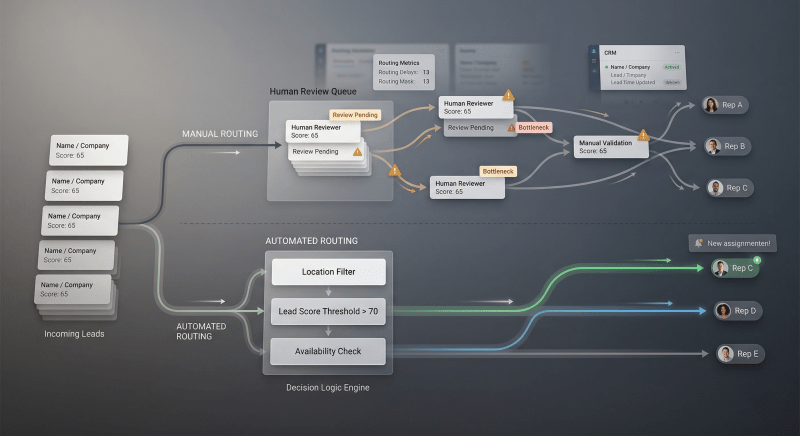
Modern routing systems are dynamic, automated, and data-driven. They assign leads instantly based on multiple conditions—source, score, behavior, and availability—and trigger immediate follow-up actions.
Example: A lead submits a demo form. The system instantly scores the lead, checks territory and availability, assigns it to the correct rep, and triggers a Slack notification—all within seconds.

Learn implementation strategies in how to automate lead routing.
Before vs After: Manual vs Automated Lead Routing
Manual routing: Leads sit unassigned for 15–60 minutes, ownership is unclear, and multiple reps may contact the same lead—or no one at all.
Automated routing: Leads are assigned instantly based on rules, the correct rep is notified immediately, and follow-up happens within minutes.
For a deeper comparison, explore lead response time automation.
If your current process looks closer to the manual version, you’re likely losing leads every day without realizing it.
System insight: Lead routing is not standalone
Lead routing is one layer of a larger system that includes capture, scoring, response, and follow-up. If one layer fails, the entire system underperforms.
Explore full solutions under automation solutions or foundational systems in automation guides.
FAQ
Is lead routing only for large sales teams?
No. Even small teams benefit because routing eliminates delays and ensures every lead is handled correctly.
What’s the difference between lead routing and lead assignment?
Assignment is the action. Routing is the system that ensures the right action happens at the right time.
Can lead routing be automated without a CRM?
Yes, but without a centralized system, visibility and scalability become limited.
How fast should lead routing happen?
Ideally instantly. Even small delays significantly reduce conversion probability.
Conclusion
Lead routing is not a minor operational task—it’s a revenue-critical system.
When it works, leads move fast, sales teams stay efficient, and conversions increase. When it fails, everything downstream breaks.
The companies that win aren’t the ones working harder—they’re the ones responding first, with the right system behind them.
Next step
If your lead routing feels slow, inconsistent, or manual, the issue is likely deeper than assignment.
Get a full system diagnosis and identify where your process is breaking:
Or explore implementation options under automation services.