
Systems don’t fail because APIs exist — they fail when payloads don’t match schemas, rate limits block execution, or silent API errors break downstream workflows. This solution builds controlled API integrations that validate, transform, and route data reliably across systems under real conditions.
If your integrations intermittently fail, duplicate data, or silently desync systems, this solution outlines how to stabilize them. Request an API integration audit.
What this solution covers
Event-driven and scheduled API integrations, including validation, transformation, retries, and system synchronization across CRM, ERP, and third-party platforms where schema mismatches and API limits commonly cause failures.
This is the execution layer of automation — it ensures data moves reliably between systems, while solutions like data sync maintain consistency and workflow automation define process logic.
What this solution does NOT cover
- Business logic like lead routing (handled in lead routing)
- AI-based decision systems (handled in AI workflow automation)
- Data extraction or document parsing workflows
When API integrations start breaking in production
Failures emerge when APIs change without notice or payloads arrive incomplete under load.
Without control, retries duplicate records, partial syncs corrupt data, and silent failures propagate across systems.
Teams and operations that depend on stable integrations
For RevOps, finance, and operations teams, high-frequency API dependencies mean even minor delays or inconsistent responses quickly compound into billing errors, missed updates, and broken workflows.
How integration failures show up in real workflows
Inconsistent API behavior surfaces before errors are logged — data arrives late, duplicates appear in CRM, or systems drift out of sync due to missed events, failed API calls, or malformed responses that pass validation.
Manual fixes increase as teams compensate for unreliable automation. The failure points are illustrated below.

How the integration system operates under real conditions
Events are captured, validated, transformed, and routed through controlled API calls with retries and fallback handling, as shown below.
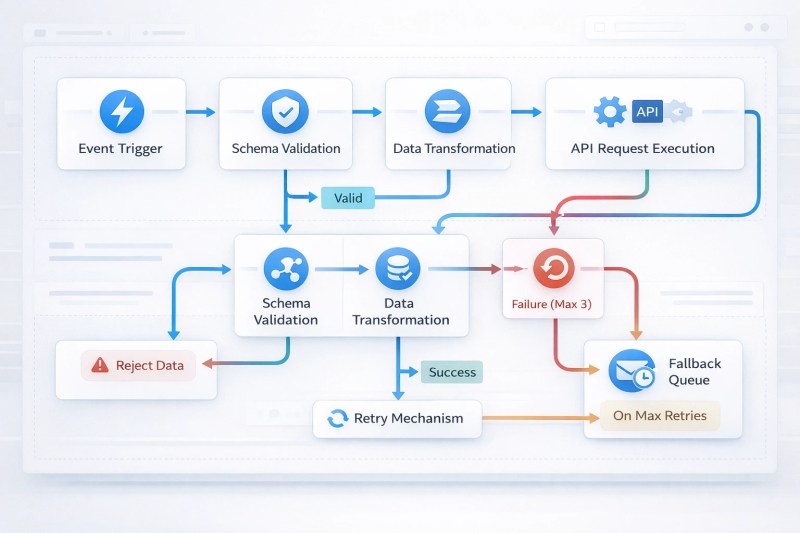
- Webhook/event → validate schema to prevent malformed payloads → transform data to match API format → send request with idempotency key to avoid duplicates → retry or fallback on failure to prevent data loss
- Scheduled sync → detect data changes to avoid full reloads → batch and throttle API calls to stay within rate limits → reconcile mismatches to correct inconsistent records; without this, systems diverge with stale or conflicting data
When validation is missing, malformed data breaks APIs; when retries lack control, duplicate records are created.
How failures are contained and controlled
APIs operate under constraints: rate limits, latency, and unpredictable responses require strict governance, as illustrated below.

- API timeout or 5xx error → retry with exponential backoff to avoid immediate repeat failure; without this, transient outages cause permanent data gaps
- Repeated failures beyond retry limit (e.g., 3–5 attempts) → move to fallback queue for later processing; without this, failed records are lost or require manual re-entry
- Rate limit response (429) → trigger throttling to delay requests; without this, APIs block access entirely and halt workflows
- Repeated failures beyond threshold (e.g., 5 failures within a short window) → circuit breaker pauses execution to stop further requests; without this, failing APIs cascade errors across dependent systems
Without these controls, failures go undetected and systems drift out of sync.
Example: CRM and billing system sync under load
A deal closes in CRM, triggering billing system creation via API.
- Deal event → validate fields to prevent missing invoice data → transform to billing format → create invoice via API with idempotency → confirm response or retry to prevent missed billing
- API timeout → retry within SLA to recover transient failures → move to fallback queue if unresolved → escalate after repeated failure to prevent revenue loss
Without fallback, invoices are missed; without idempotency, duplicates are created.
How integrations are implemented in practice
Implementation follows controlled steps to prevent failures during deployment, especially where API behavior is inconsistent or undocumented (see common integration mistakes).
- Map systems and endpoints → identify required fields and constraints; missing this causes schema mismatches during execution
- Validate API behavior → test edge cases like missing fields and rate limits; without this, failures only appear in production
- Build workflows with retries, logging, and fallback → ensures failures are captured and recoverable; otherwise, errors go unnoticed and require manual reconstruction
- Run controlled rollout → monitor logs and error rates; without this, failures scale silently across systems
Platform selection depends on complexity (see Zapier vs Make vs n8n).
Need reliable integrations without silent failures? Start API integration implementation.
What this system depends on
Reliable APIs, defined schemas, authentication stability, and system availability.
When these conditions are unstable or undefined, integrations cannot execute reliably.
Systems this connects and coordinates
CRMs, ERPs, payment systems, document tools, and external SaaS platforms where API limits, authentication failures, or schema differences can break integrations, often requiring cross-platform workflow automation.
For structured data consistency, see data sync automation and CRM automation guide.
How integration performance is measured
Success depends on execution reliability and data consistency across systems.
- API success rate, retry frequency, sync latency, data mismatch rate
- Error logs, fallback queue volume, SLA adherence
Without monitoring, failures remain undetected until business impact occurs.
What improves when integrations stabilize
Systems remain synchronized even under API delays or partial failures, manual fixes decrease, and workflows execute without interruption, as shown below.

Data consistency improves across CRM and operations (see CRM updates automation).
Where human intervention is still required
Schema mismatches, API deprecations, and unresolved failures — such as an API returning valid responses with incorrect data — require manual review.
Escalations ensure edge cases are handled without breaking the system.
Next steps and related resources
Explore solutions:
All automation solutions,
data sync automation,
CRM updates automation.
Explore guides:
All automation guides,
business process automation.
Explore services:
All automation services,
API integration services.
Read more:
Automation blogs,
how to connect multiple systems,
common integration mistakes.
Frequently asked questions
- What happens when an API fails?
Retries execute within SLA; unresolved failures move to fallback queues and trigger alerts. - How do you prevent duplicate data?
Idempotency keys and validation rules ensure repeated calls don’t create duplicates. - Can this work with any platform?
Yes, provided APIs are accessible and documented, but integrations depend on API reliability, documentation quality, and authentication stability. - What happens when APIs change without notice?
Schema validation and monitoring detect changes early, triggering alerts and fallback handling before corrupted data spreads across systems. - How do you handle partial or inconsistent API responses?
Validation layers check payload completeness and structure before processing; incomplete or malformed responses are retried or routed to fallback queues.
Why Alltomate
We design API integrations that operate under real-world constraints — not ideal conditions. Every workflow includes validation, retries, and failure control to prevent silent system breakdowns.
Reduce failed API calls, prevent duplicate data, and keep your systems reliably in sync.