
A reconciliation can appear balanced while unmatched records remain hidden by inconsistent identifiers, date formats, currencies, settlement timing, or tolerance rules. When teams compare exports manually, the final result often depends on spreadsheet formulas and individual judgment that cannot explain why one record matched while another was excluded.
Reconciliation automation creates one controlled workflow for collecting source records, standardizing fields, applying approved matching rules, routing unresolved differences, recording corrections, updating connected systems, and proving that every record reached a defined outcome.
If reconciliation still depends on downloading files and rebuilding comparisons by hand, see how Alltomate connects data across business systems.
System Snapshot
- Problem: Records from separate systems cannot be compared reliably when identifiers, dates, amounts, currencies, and transaction states use conflicting formats.
- Core System: A controlled reconciliation engine collects, normalizes, matches, evaluates tolerances, routes exceptions, records resolutions, and confirms completion.
- Key Risk if Missing: False matches, duplicate adjustments, unresolved differences, and incomplete source files can produce a clean-looking report that does not reflect the underlying records.
- Primary Outcome: Every record receives a traceable matched, partially matched, unmatched, excluded, or resolved status with supporting evidence.
Where Reconciliation Breaks Before Matching Begins
This solution fits recurring reconciliations where transactions, balances, invoices, payments, fees, orders, or operational records must agree across two or more sources. The failure usually begins before matching: one system exports a transaction reference while another stores only a payout ID, a bank description truncates the customer name, or a late settlement falls into a different reporting period.
A small, stable dataset may not require a separate reconciliation workflow if the source platform already provides reliable matching and exception reporting. Automation becomes necessary when record volume, source count, timing differences, tolerance rules, or manual corrections make it impossible to reproduce the result consistently.
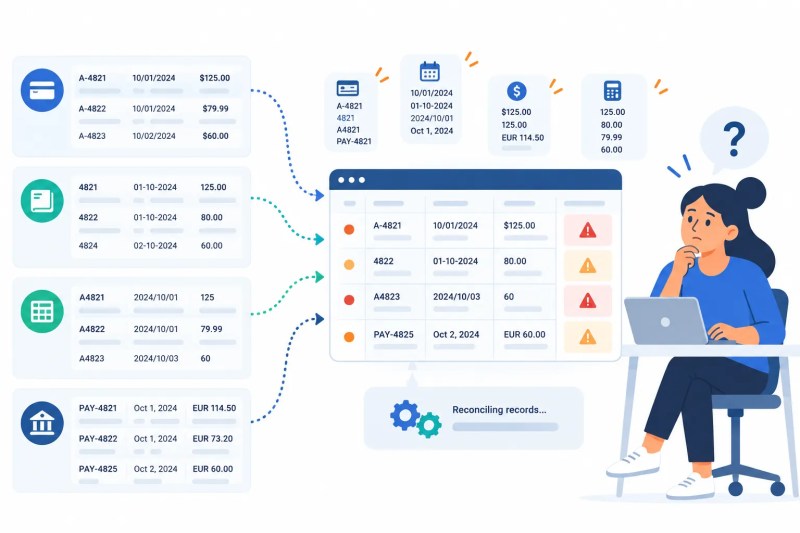
The failure state is shown below: records describing the same transaction arrive with incompatible identifiers, dates, currencies, and amounts, preventing reliable matching.
One Reconciliation Run From Source Collection to Sign-Off
Each run starts with a defined reconciliation period, expected sources, source-specific cutoffs, and a unique run identifier. The workflow does not begin matching until required files or API responses pass completeness checks, because comparing one complete ledger against a partial payment export can create thousands of false exceptions.
After normalization, the engine applies exact and approved conditional matching rules without allowing the same record to satisfy two match groups. Unresolved differences enter an owned exception queue, and the run cannot close until every included record has a final status or an authorized exclusion.
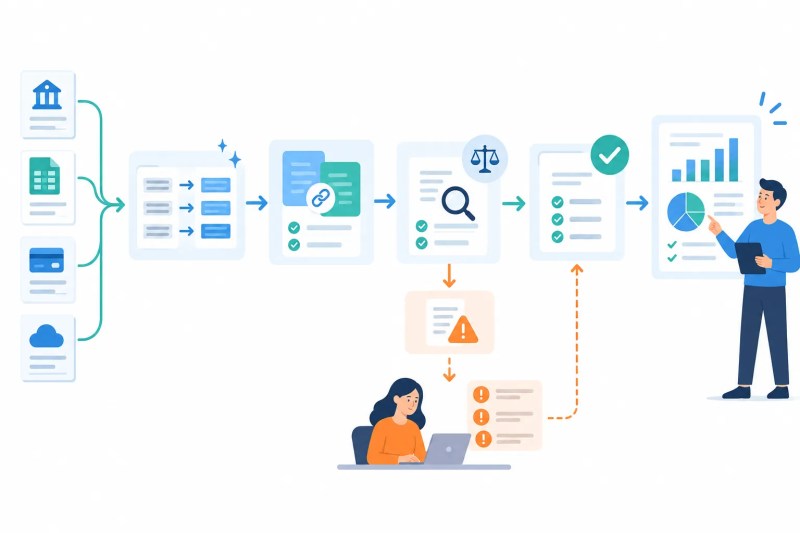
- Collect → retrieve every required source for the run → register source status (missing or incomplete source → hold the run)
- Normalize → standardize identifiers, dates, amounts, signs, and currencies → create comparable records (invalid field → validation exception)
- Match → apply exact and conditional rules → create unique match groups (duplicate candidate → ambiguity queue)
- Evaluate → compare amount and timing differences against approved tolerances → classify the result (unsupported variance → exception)
- Resolve → assign mismatches with evidence and due state → record correction or explanation (unowned item → escalation)
- Close → verify all records and updates → issue completion report (unresolved population → block sign-off)
The complete workflow appears below, including the exception path that prevents unresolved records from being included in the completed population.
The reconciliation is one component within the broader architecture covered in the business process automation guide. That surrounding process may create or move the records, while the reconciliation engine is responsible for proving whether the selected populations agree.
Once matching rules, tolerance decisions, and corrections are scattered across spreadsheets and individual inboxes, the problem is a system-design risk rather than a tool-selection issue. Map the reconciliation architecture before another close depends on undocumented matching logic, because adding a new connector will not correct weak identifiers or ambiguous exception ownership.
Matching Rules Must Survive Missing References and Timing Differences
Exact matching works only when both sources retain the same stable identifiers and amounts. Real datasets often require controlled alternatives such as one invoice matching several payments, several invoices matching one deposit, or a transaction matching after fees, refunds, or settlement delays change the value recorded in the destination system.
Conditional rules must run in a defined order so a broad date-and-amount match cannot consume a record that should have matched by transaction ID. When more than one candidate satisfies a rule, the engine should classify the result as ambiguous instead of selecting the first record returned by an API or spreadsheet.
| Matching condition | System behavior | Failure control |
|---|---|---|
| Stable identifier and exact amount | Create a direct one-to-one match | Reject the match if either record is already assigned elsewhere |
| Amount matches within an approved date window | Create a conditional match candidate | Route multiple candidates for review instead of selecting automatically |
| One record corresponds to several records | Build a grouped match and compare the group total | Require every component to remain unique to that group |
| Amount differs within tolerance | Apply the relevant tolerance rule and retain the variance | Prevent closure if the rule, currency, or policy version is missing |
| No approved rule produces a unique result | Create an unmatched exception | Assign an owner and preserve all candidate evidence |
Tolerance Rules Decide Which Differences Can Close Automatically
A tolerance is an approved decision rule, not a general instruction to ignore small differences. The reconciliation must identify whether the permitted variance is absolute, percentage-based, currency-specific, account-specific, or caused by known timing, fee, tax, or rounding behavior.
If tolerance rules are changed without versioning, a rerun can produce different results for the same source population and make an earlier sign-off impossible to explain. The workflow therefore stores the rule version used by each match and prevents unsupported differences from being converted into automatic resolutions.
Control Layer
- Every run uses a unique identifier, defined period, required-source checklist, and recorded source cutoff.
- File and API inputs are checked for missing columns, duplicate rows, unexpected currencies, malformed dates, and incomplete pagination before matching starts.
- Normalization preserves original values so transformed identifiers and amounts can be traced back to the source record.
- Matching rules execute in a fixed priority order and prevent one source record from entering multiple completed match groups.
- Tolerance rules are versioned by amount, percentage, currency, account, transaction type, and effective period where relevant.
- Ambiguous candidates, unsupported variances, and missing references enter an owned exception queue instead of being forced into a match.
- Retries and reruns use idempotent run and record keys so a repeated webhook, upload, or API request cannot duplicate adjustments.
- Source-system updates require success confirmation; rejected or partially applied updates remain open until reconciled with the destination response.
- Final sign-off is blocked while required sources, unmatched records, failed updates, or unapproved exclusions remain unresolved.
The decision structure below separates exact matches, grouped matches, approved variances, and ambiguous candidates instead of treating every difference the same way.

Execution failures around imports, API calls, or downstream updates belong to workflow error monitoring. The reconciliation system uses those failure signals, but it separately owns whether the record population has been matched and resolved correctly.
Example: Reconciling Payment Records Against Bank Deposits
Consider a daily run that compares payment-platform transactions, payout records, accounting entries, and bank deposits. A single bank deposit may represent many customer payments after fees, refunds, disputes, and settlement delays, so matching each payment directly to the deposit amount would create false differences.
The workflow first groups transactions by payout identifier, validates the payout total, and then matches that payout against the corresponding bank deposit within an approved settlement window. Stripe’s bank reconciliation documentation illustrates the same operational distinction between payment activity, payouts, cash received in the bank, and outstanding amounts.
If the bank deposit is late, the record remains an open timing exception rather than being written off as a mismatch. If the deposit amount differs, the engine exposes the component transactions and fees so a reviewer can identify whether the variance came from source data, timing, currency conversion, or an actual posting error.
The example below shows why customer payments cannot always be matched directly to a bank deposit without first accounting for payout grouping, fees, and refunds.

Records Required Before Automated Matching Can Begin
Each source needs a stable record key, transaction date, effective or settlement date where relevant, signed amount, currency, status, source-system identifier, and reconciliation period. When an export supplies formatted amounts as text, omits timezone information, or reuses human-readable references, the validator must resolve or reject those fields before matching.
The system also requires documented matching priority, allowed groupings, tolerance ownership, exception categories, authorized exclusions, correction rules, and completion criteria. Without those definitions, automation can compare data but cannot determine whether a difference is acceptable, temporary, or evidence of an unresolved error.
These inputs often originate inside broader invoice, payment, order, reporting, or operational workflows described in the back-office automation guide. Reconciliation should verify their outputs without silently repairing upstream data defects that the source process still needs to address.
APIs and Source Files Rarely Describe the Same Transaction Identically
Reconciliation automation can connect accounting systems, payment platforms, banking exports, CRM records, ERP data, spreadsheets, databases, and internal applications through APIs, webhooks, scheduled exports, or secure file transfers. Those sources may disagree on field names, sign conventions, timezone boundaries, decimal precision, and whether fees or reversals appear as separate records.
APIs also introduce pagination, rate limits, delayed availability, and incomplete historical fields, while webhooks can arrive more than once or out of sequence. The collection layer therefore records retrieval boundaries and source counts, deduplicates repeated events, and confirms that a complete period has been received before treating the run as ready.
A connector should not become the hidden source of truth. If the source application changes an identifier or response schema, the reconciliation must fail visibly at validation rather than continue matching against shifted fields and produce an apparently successful but inaccurate completion report.
Completion Reporting Must Prove What Matched and What Did Not
A run is complete only when the expected source population equals the combined population of matched, unmatched, excluded, and resolved records, with no record counted twice. A report that shows only the matched percentage can hide missing source records, failed updates, or exceptions removed from the working spreadsheet.
The completion package should retain source counts and totals, normalization results, matching-rule distribution, tolerance usage, unresolved items, resolution evidence, source-system update responses, reviewer actions, and sign-off status. If a rerun changes a result, the new version must remain distinguishable from the previously reviewed output.
Result: Each reconciliation run ends with a traceable population, explainable match logic, owned exceptions, confirmed updates, and evidence showing why the period was approved or left open.
The completion state below keeps one unresolved exception visible, demonstrating why a reconciliation should not close merely because most records matched.

Reconciliation Metrics That Reveal Hidden Manual Work
Useful measures include automatic match rate, ambiguous-match rate, unmatched value, aged exception count, average resolution time, manual correction volume, tolerance usage by rule, rerun frequency, failed source updates, and records received after cutoff. A high automatic match rate is not healthy if a broad rule is incorrectly absorbing records that should remain unmatched.
Metrics should be segmented by source, account, transaction type, reconciliation period, rule version, and exception cause. Otherwise, a small set of recurring data-quality failures can disappear inside an overall completion percentage and continue generating manual work every cycle.
Rule growth should also be monitored because repeated one-off conditions can create automation debt. If reviewers can no longer explain which rule wins when several candidates qualify, the matching engine has become harder to audit than the manual spreadsheet it replaced.
Human Review Begins Where Matching Evidence Stops
Automation can validate source completeness, standardize fields, apply deterministic rules, calculate tolerances, assemble candidate groups, route exceptions, and retain resolution evidence. It should stop when available data cannot uniquely identify a match, when a variance requires policy interpretation, or when a correction could alter a controlled accounting or operational record.
Human reviewers should select from defined resolution outcomes, attach supporting evidence, and record why an item was corrected, excluded, deferred, or escalated. Free-text edits without an owner, timestamp, and source reference make the next reconciliation depend on memory instead of an auditable decision.
Frequently Asked Questions
What records can reconciliation automation compare?
It can compare transactions, balances, invoices, payments, payouts, fees, orders, inventory movements, and other records when each source exposes stable identifiers or defensible matching attributes. If a source omits required dates, amounts, currencies, or references, the workflow must validate or hold those records before matching.
Can automated reconciliation handle one-to-many matches?
Yes, when grouping rules define which records may form one match and ensure that no component is reused elsewhere. If several different groups satisfy the same rule, the result should enter an ambiguity queue instead of closing automatically.
How are acceptable reconciliation differences handled?
Approved tolerance rules can classify differences caused by rounding, fees, currency conversion, or timing without hiding the actual variance. If no valid rule applies to the account, currency, period, or transaction type, the difference remains an exception.
What happens when one reconciliation source arrives late?
The run should remain incomplete or enter a controlled waiting state until the required source arrives or an authorized exclusion is recorded. Matching a partial population against a complete source can generate false exceptions and an inaccurate completion total.
Can the system update accounting or source records automatically?
It can send approved corrections or status updates when the destination supports a reliable API and the action follows defined authorization rules. A rejected, duplicated, or partially applied update must remain open until the destination response is confirmed.
Does reconciliation automation remove the need for human review?
No, because ambiguous matches, unusual variances, policy exceptions, and controlled adjustments still require accountable judgment. Automation narrows the review population and preserves evidence, but it should not invent certainty when the source records do not support a unique decision.
Why Alltomate
Alltomate is a Zapier Certified Platinum Solution Partner founded by Miguel Carlos Arao. Reliable reconciliation requires more than moving rows between systems: the workflow must preserve source boundaries, normalize data without losing evidence, prevent duplicate matching, control tolerance rules, route unresolved differences, confirm downstream updates, and block sign-off when the population is incomplete.
If your team cannot reproduce why records matched, why a variance was accepted, or why a period was closed, start with a free business process audit to map the sources, matching rules, exception ownership, and completion controls.
About the solution designer

Miguel Carlos Arao is the Founder of Alltomate and a
Zapier Certified Platinum Solution Partner specializing in automation
systems, workflow architecture, and real-world implementation.

Built by a certified Zapier automation partner
Explore more at
business process automation resources,
workflow reliability monitoring, and
automation maintenance guidance.