
Tasks don’t fail because they’re unclear—they fail because ownership silently breaks between steps, leaving work unclaimed or duplicated. This system enforces state-driven handoffs where each transition is validated, acknowledged, and recoverable under failure.
In simple terms: every task must be accepted before it moves forward.
Fix task handoff failures before ownership breaks in the workflows you already rely on.
System Snapshot
- Problem: Tasks lose ownership during transitions between people or systems
- Core System: State-driven task handoff workflow with acknowledgment and fallback logic
- Key Risk if Missing: Work stalls, duplicates, or disappears without visibility
- Primary Outcome: Every task transition is tracked, confirmed, and recoverable
Task Handoffs Break When Ownership Is Assumed Instead of Enforced
This system controls how tasks move between people and systems by enforcing ownership validation, acknowledgment, and reassignment at every state change, which becomes even more critical in automated workflows where decisions are made by rule or logic. It becomes necessary when status updates fail to trigger the next step, causing tasks to sit unclaimed or duplicated because teams assume someone else owns them. Without this structure, delays, schema mismatches, or missed notifications break continuity and leave work silently incomplete.
System Architecture and Workflow Logic
A task can appear completed in one system while remaining unassigned in another when state transitions are not validated across platforms. This system prevents that by enforcing ownership validation before any transition is allowed to complete.
Each handoff follows a controlled 3-step cycle. The diagram below shows how ownership is enforced at each transition.

- Trigger → status change detected → validate task + assign next owner (invalid or unmapped values → block + notify to prevent incorrect ownership assignment)
- Handoff → notify owner → await confirmation (no response or delivery failure → retry → escalate to ensure the task does not remain unclaimed)
- Sync → update all systems → confirm consistency (sync fails → queue + retry because updates can partially succeed across systems, ensuring systems do not diverge or create duplicate work; this step validates ownership state, not full data synchronization)
Without validation at each transition, tasks can advance with incomplete data or incorrect ownership, creating downstream errors that are harder to detect. This structure prevents silent progression by enforcing checkpoints before any step completes.
How the System Recovers When Handoffs Break
Task handoffs fail under delays, missed notifications, and system sync issues, so governance enforces time-based and event-based controls to detect and recover from these failures. Without this layer, tasks appear complete while remaining unassigned or unresolved.
The failure paths below show how the system detects and recovers from broken handoffs.
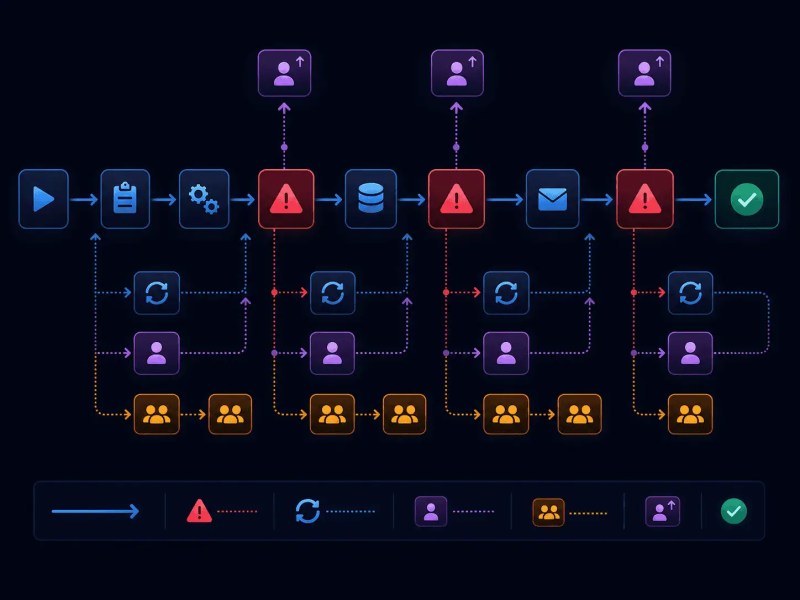
Control Layer
- SLA timers trigger when ownership is not confirmed due to missed notifications or delayed responses, escalating tasks before they remain unassigned indefinitely and ensuring stalled tasks are surfaced early
- Retry logic activates when notification delivery fails or API requests time out, preventing handoffs from silently failing due to delivery issues and ensuring ownership transitions complete reliably
- Fallback assignment triggers when no acknowledgment is received after defined retries, indicating the assigned owner is unavailable and ensuring tasks are reassigned instead of remaining blocked
- Logging activates on every state transition and failed update attempt, allowing detection of where ownership breaks and ensuring failures are traceable across the workflow
- Escalation rules activate when tasks exceed SLA timers or retry limits between steps, preventing delays from remaining invisible to management and ensuring issues are surfaced for resolution
If ownership is not explicitly enforced at every transition, tasks will continue to move without accountability, regardless of the tools used. Fix the handoff logic at the system level before scaling workflows that silently lose ownership.
Example Implementation and System Dependencies
A sales-qualified lead moves from marketing to sales, but the CRM status update doesn’t trigger assignment because the status changes to “SQL” while the system expects “Sales Qualified,” creating a mismatch that prevents ownership assignment—a common issue in manual CRM data entry. Unlike lead assignment systems that determine who should own a lead, this system ensures ownership transitions are confirmed and completed. The system detects the missing handoff, blocks progression, and escalates, preventing the lead from sitting unassigned while both teams assume ownership was transferred.
The break point below shows how this mismatch interrupts the handoff.

In implementation, status triggers are validated against expected field schemas and allowed status values, preventing unmapped or mismatched inputs from advancing tasks and assigning incorrect owners. Notification steps use confirmation trackers that monitor acknowledgment updates written back to the task state, so tasks do not proceed without acknowledgment and ownership gaps do not stay invisible.
API sync operations use retry queues that store failed updates when rate limits or downtime occur, preventing partial updates across systems that create conflicting task states, similar to issues seen in document processing workflows. Ownership assignment includes fallback routing logic, ensuring tasks are reassigned when users are inactive or unavailable, otherwise tasks remain unowned and block downstream steps.
This system relies on consistent task identifiers and status definitions across platforms, where mismatched schemas can break trigger logic, similar to issues seen in CRM data entry automation and CRM cleanup workflows. It also depends on reliable notification channels, since delayed or blocked messages can prevent confirmation and stall workflows.
Tools This System Works Across
CRMs like HubSpot or Salesforce use different status schemas, requiring mapping layers because mismatched values can trigger incorrect ownership transitions, similar to challenges in CRM updates automation. Notification tools like Slack or email introduce delivery delays or failures, and APIs impose rate limits, which, if unhandled, cause missed handoffs and inconsistent task states across systems. While system integration workflows focus on connecting platforms, this system focuses on enforcing ownership across those connections, especially in API integrations and scenarios discussed in connecting multiple systems.
What We Measure and System Results
We track time-to-acknowledgment for each handoff, since delays indicate breakdowns in ownership visibility, especially in systems like lead routing where ownership speed is critical. Failed or retried transitions are logged to identify system gaps that would otherwise cause silent task loss, a common issue discussed in CRM pipeline problems.
Result: Tasks no longer disappear between teams, ownership is visible at every step, and when failures occur, there is a clear audit trail showing exactly where the handoff broke.
The result below shows how validated handoffs maintain continuous ownership and visibility.

What Automation Cannot Decide on Its Own
Exceptions like ambiguous task context or conflicting priorities require manual intervention, since automated assignment cannot interpret unclear ownership rules. Teams must still resolve edge cases where system logic cannot determine the correct next step, especially in workflows discussed in manual vs automated workflows or when coordinating with cross-platform workflows.
Next Steps and Related Resources
Explore task handoff and workflow guides to understand ownership transfer and workflow control, or browse automation solutions to see how handoff logic applies across different use cases.
For implementation support, review automation services for build and rollout guidance, or learn from real-world automation case studies in automation blogs.
For related systems, review data sync automation for maintaining data consistency across platforms and CRM lead assignment, where ownership logic must remain consistent across steps.
Frequently Asked Questions
Can task handoffs work without confirmation tracking?
They can move tasks forward, but without confirmation, ownership gaps remain invisible and tasks may stall unnoticed. Missing acknowledgment leads to silent failures where no one realizes work is unclaimed. This is why confirmation tracking is a core part of how this system is built, not an optional add-on.
What happens if systems are not fully synced?
Tasks can appear complete in one system while remaining pending in another, causing duplicate or missed actions. Without sync validation, inconsistencies propagate across workflows and break downstream steps. This system handles partial sync failures through retry queues and consistency checks before any transition completes.
Does this replace lead assignment or data sync workflows?
No. Lead assignment decides who owns the task, and data sync keeps records aligned; this system verifies that ownership actually transfers between steps. Without that separation, handoffs can look complete while responsibility never changes.
Which platforms does this system work with?
This system is built to work across CRMs like HubSpot and Salesforce, notification tools like Slack and email, and any platform connected via API. The specific requirement is consistent task identifiers and status definitions across those platforms — mismatched schemas are the most common source of broken handoffs and need to be mapped before the system can enforce transitions reliably.
Why Alltomate
Most automation setups move tasks forward without verifying ownership, which is why work continues to break at handoff points. Alltomate designs systems with validation layers, confirmation tracking, and failure recovery built into every transition, ensuring ownership is not just assigned but actually transferred.
Work with Alltomate on handoff validation and failure recovery before scaling workflows that depend on consistent ownership transfer.
About the solution designer

Miguel Carlos Arao is the Founder of Alltomate and a Zapier Certified Platinum Solution Partner specializing in automation systems, workflow architecture, and real-world implementation.

Built by a certified Zapier automation partner
Explore more at
CRM automation guide,
data sync solutions, and
workflow automation insights.