
An AI summary can be grammatically clean, high-confidence, and still omit the renewal date that changes a customer or CRM decision. AI output review automation creates a controlled gate between generation and action, so unsupported claims, missing evidence, and malformed payloads do not quietly enter a business workflow.
See how Alltomate structures AI-powered automation when generated output needs a controlled review step before release.
System Snapshot
- Problem: AI output can sound credible while lacking evidence, required fields, or safe downstream formatting.
- Core System: A review gate validates the output package, sources, confidence, and approval status before release.
- Key Risk if Missing: Unsupported or malformed output can update live records, mislead customers, or trigger the wrong action.
- Primary Outcome: Validated outputs move forward while uncertain, contradictory, or malformed outputs enter a traceable review queue.
A polished AI answer can still be unsafe to use
This solution reviews AI-generated summaries, drafted text, extracted values, and decision recommendations before they trigger downstream action. It is useful when an output can affect a customer, a record, or an operational decision.
It does not replace AI email-response automation that creates a reply or AI document classification that determines what a file is. A small internal brainstorming task may not need this governance, but an output that can change a CRM record or customer-facing message needs a defined failure path.
The gate may review a generated score or proposed routing decision before it affects operations, but it does not create the AI lead score or perform AI support-ticket routing itself.
The missing-evidence failure is shown below: a polished output remains blocked when its key fact cannot be traced to the source.

The review gate begins before an output reaches an inbox or record
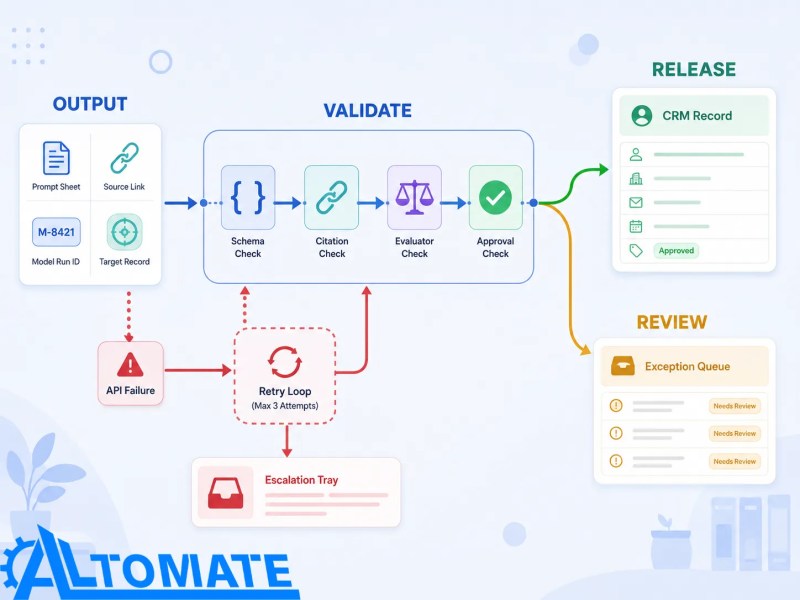
The workflow receives an output package containing the generated answer, prompt version, source references, intended action, model-run identifier, and target record ID. A validator checks those elements before the output can update a record, create a task, or enter an approval queue.
A valid AI endpoint response can still contain an unsupported claim, blank source URL, or status value that the destination does not recognize. Reviewing it after the write leaves the team correcting a live record instead of stopping the payload.
- Output package → attach prompt, sources, identifiers, and intended action → send to validation (missing context → hold for review)
- Review gate → test schema, evidence, evaluator result, and confidence → approve or reject (failed condition → exception queue)
- Release → execute the approved downstream action and log the decision (API failure → bounded retry, then escalation)
The complete release path is shown below, including the branch that sends failed validation into an exception queue.
Rules, citations, and evaluator disagreement cannot share one pass condition
Deterministic rules can reject a missing “record_id,” blank “source_url,” unsupported “decision” value, or incorrectly typed field — the structural checks defined by the JSON Schema specification. These checks confirm that the payload is structurally usable, but they cannot establish whether the answer accurately represents its source.
Citation validation tests whether the required evidence exists and whether the referenced material supports the relevant claim. A secondary evaluator can flag contradiction or incomplete reasoning, but it can still repeat the first model’s weak assumption.
Confidence therefore acts as a routing signal rather than an approval certificate. A high-confidence output moves forward only when the schema, evidence, permitted values, and evaluator result also pass.
The comparison below separates the structural, evidentiary, and evaluator conditions that must be checked before release.

Control Layer
- A JSON schema validator rejects missing identifiers, malformed objects, unsupported enum values, and incorrectly typed fields.
- A citation check holds outputs with a missing source URL, unavailable evidence, or a claim that cannot be traced to the supplied material.
- A confidence threshold routes uncertain outputs to review instead of treating model certainty as proof of accuracy.
- A disagreement handler creates an exception when the secondary evaluator contradicts the proposed answer on a material fact.
- A bounded retry requests corrected formatting only when the failure is recoverable; repeated failures escalate with the original payload preserved.
- An approval log records the prompt version, model-run ID, sources, validation results, reviewer decision, and downstream action.
When AI review is reduced to a confidence setting, the failure is architectural: the workflow has no dependable way to stop an unsupported output before it changes work downstream. Alltomate can design the validation, exception, and approval path around the outputs your business cannot safely release without review.
One missing renewal term can become a live-record error
Consider an AI workflow that reads a vendor document and prepares a renewal summary for a CRM record. Its JSON response contains the correct record ID and a proposed renewal date, but the source URL does not point to the clause supporting that date.
The review gate holds the update, records the evidence failure, and creates a reviewer task instead of writing an unverified value. It sits after AI data extraction and before the CRM update, allowing extraction to finish without treating an unsupported value as an approved fact.
Malformed JSON must stop before the downstream API call
A structured-output validator checks that required properties such as “record_id,” “source_url,” “decision,” and “review_status” exist and use the expected data types. The payload is held before the API request when any required condition fails.
Common failures include:
- “review_status” is missing from the generated object.
- “decision” contains a value outside the approved list.
- The record ID belongs to the wrong object type.
- A required property contains an empty string.
- The destination accepts a value under the wrong field.
A bounded retry can request corrected JSON when the failure is formatting-related. Repeated malformed responses, inaccessible sources, or incomplete evidence must stop and enter review instead of consuming more processing without improving the result.
Once an approved payload is released, workflow error monitoring handles a different risk: failed API calls, ambiguous writes, and unsafe retries after execution has already begun.
A reviewer needs the source, prompt, and rejection reason together
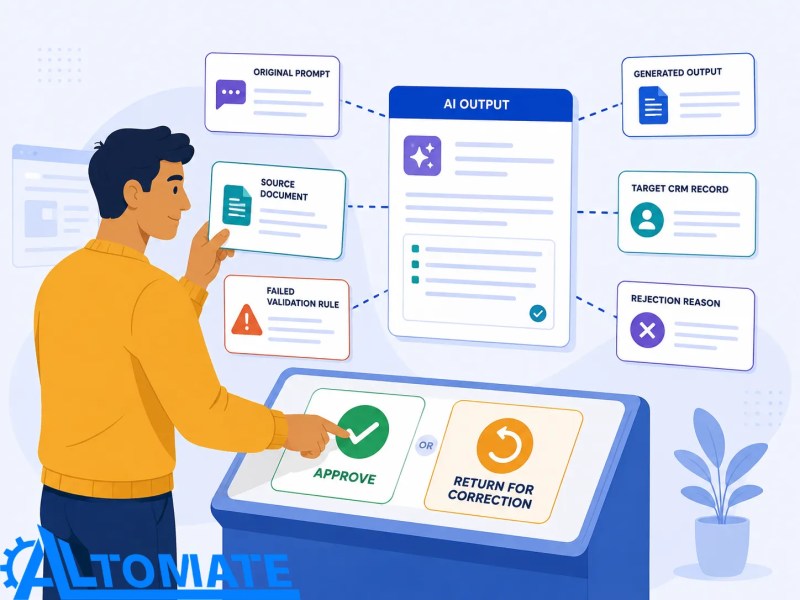
Human approval only works when the reviewer can see why the gate stopped the output. A queue containing only the final answer forces someone to reconstruct the task and search for the missing context.
Each review item should include:
- The original request and prompt version
- The generated output and model-run ID
- The target record or downstream action
- The cited sources and available evidence
- The failed rules or evaluator disagreement
- The reason the action was blocked
Without this context, approval becomes a manual rewrite process. Recurring failures also remain hidden instead of becoming improvements to the validator, prompt, or source workflow.
The review package below shows the context a person needs before choosing approval, correction, or rejection.
A high pass rate can hide costly false approvals
Useful measurement goes beyond the percentage of outputs released automatically. The system should track schema failures, unavailable citations, evaluator disagreements, reviewer overrides, review turnaround time, retry exhaustion, and outputs corrected after release.
A high pass rate paired with repeated downstream corrections means the controls are approving outputs that satisfy the format without satisfying the business requirement — a pattern consistent with the broader research literature on AI calibration and honesty. The review metrics must expose that difference before inaccurate records become normal.
The review gate belongs between AI generation and downstream execution
The AI automation guide covers the broader operating model in which generation, validation, human judgment, and downstream execution have separate responsibilities. The review gate occupies one specific point in that architecture: after the output exists but before it is trusted to act.
For a practical decision on where automation should stop and judgment should begin, read when to use AI in workflows. An accurate-looking output should not proceed automatically when its source, structure, or business context is incomplete.
Frequently asked questions
What is AI output review automation?
AI output review automation checks generated output against schema rules, evidence requirements, evaluator results, confidence thresholds, and approval conditions before it can trigger a downstream action. Failed checks create a traceable exception instead of allowing the output to update a live record or reach a customer.
Can a confidence score replace human approval?
No. Confidence can prioritize the review path, but it cannot prove that an answer is supported by the correct source or safe for the intended business decision — a conclusion supported by current research on LLM confidence and calibration.
What happens when an AI output has no usable citation?
The review gate holds the output, records the missing-evidence reason, and routes it to an exception queue or requests a corrected response. Releasing it anyway creates an unsupported record that can appear authoritative after it reaches a downstream system.
Does every AI workflow need an approval queue?
No. Low-risk internal drafting may not need review, but customer-facing, record-changing, high-impact, or financially meaningful outputs need a defined failure and approval path when evidence is incomplete or the evaluator disagrees.
Why Alltomate
Alltomate designs AI workflows around the point where generated language becomes a business action. The objective is not to add human review everywhere, but to establish reliable conditions for what can proceed automatically, what needs evidence, and what must stop for judgment.
In an adjacent governance use case, Alltomate’s brand compliance automation project applied automated URL scanning, visual comparison logic, and exception flagging to replace inconsistent manual inspection. Although it did not review generative AI output, it demonstrates the same operational principle: an automated result should meet explicit criteria before a team treats it as acceptable.
If AI outputs are about to influence live records or customer decisions, work with Alltomate to design an AI output review gate around your actual payloads, sources, and approval responsibilities.
About the solution designer

Miguel Carlos Arao is the Founder of Alltomate and a Zapier Certified Platinum Solution Partner specializing in automation systems, workflow architecture, and real-world implementation.

Built by a certified Zapier automation partner
Explore more at
AI Automation,
AI Workflow Automation, and
AI-Powered Automation Services.