
Most document automation systems fail at intake, classification confidence, and exception handling—not because AI is weak, but because real-world inputs are inconsistent, duplicated, and delayed. This leads to routing errors, processing delays, and operational overhead that compounds as volume increases. This system classifies and routes documents under those conditions, ensuring they enter the correct process path without breaking downstream workflows.
Explore AI and document automation services or request a process audit to identify classification gaps, or browse our AI and document automation solutions to see related systems.
What this solution covers
AI-based classification, tagging, and routing of documents with confidence scoring, fallback handling, and reprocessing loops designed to maintain accuracy under inconsistent inputs and operational delays.
What this solution does NOT cover
- Data extraction handled by automated OCR data extraction and AI data extraction systems (see also OCR automation explained)
- Approval workflows handled by automated document approval workflows
- Storage structuring handled by automated file organization systems
When this solution is the right fit
Best for high-volume environments where inconsistent formats, duplicate submissions, and manual sorting create delays and routing errors under real workload conditions.
Who this solution is for
Operations teams handling invoices, contracts, or mixed document types where inconsistent inputs and human delays disrupt routing accuracy.
What problem usually looks like
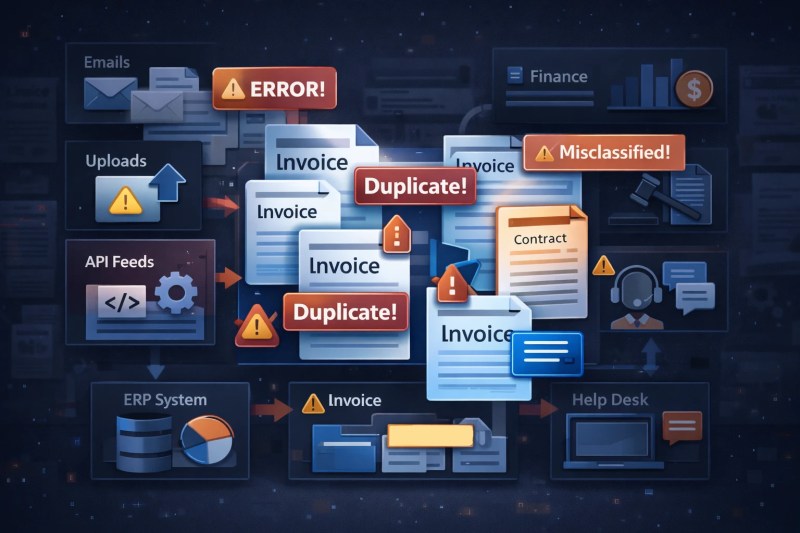
Documents arrive via email, uploads, or APIs with missing metadata, inconsistent naming, duplicate submissions, or timing gaps between channels, forcing manual triage and increasing routing errors. The failure state below shows how duplicate and inconsistent inputs create confusion before classification even begins.
System architecture and workflows
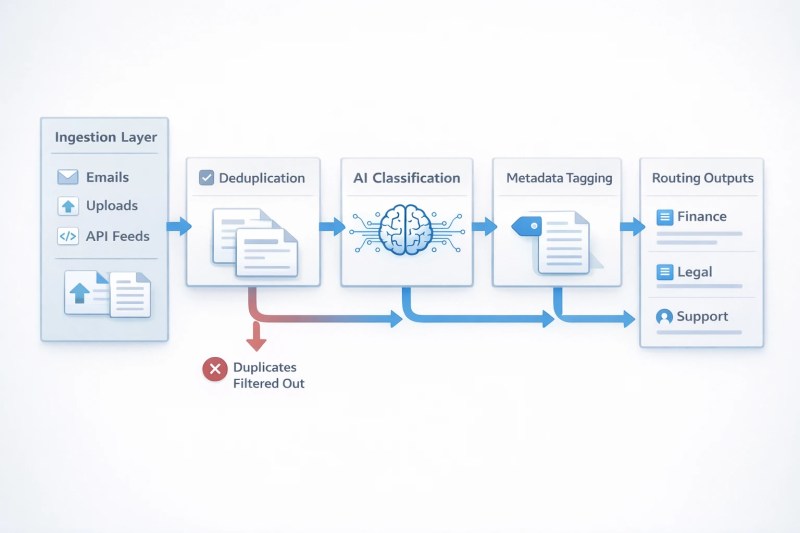
Documents enter ingestion layer → duplicates are detected and suppressed across channels → AI classifies type and intent → metadata applied → routed to correct system; without deduplication, parallel submissions create conflicting downstream records.
Confidence scoring evaluates classification certainty per document type → borderline scores route to review while low scores trigger fallback → corrected classifications are logged and reprocessed; inconsistent human corrections introduce drift and reduce classification precision over time. The system flow below shows how each stage prevents errors from propagating downstream.
Control layer and system governance
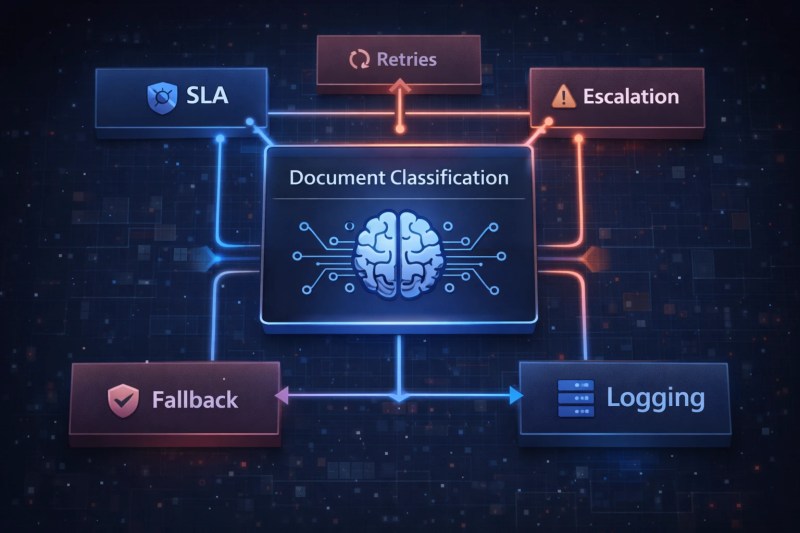
SLA enforces near real-time classification; queue thresholds trigger alerts to prevent silent backlog accumulation during volume spikes.
Retries handle API or model failures; repeated failures escalate to fallback logic to maintain flow without dropping documents.
Escalation routes uncertain cases to human review; unmanaged queues introduce delays and inconsistent decision quality.
Fallback logic maintains continuity under low confidence but must be calibrated carefully to avoid overuse and reduced accuracy.
Logging captures every classification and override; missing logs remove audit visibility and weaken model improvement cycles. The control layer below shows how these safeguards prevent silent system failures.
Need this implemented? See how we deploy AI-powered document classification and automation systems across document workflows.
Example implementation scenario
A mid-market finance team receives invoices, contracts, and support documents via multiple channels; AI classifies and routes each to finance, legal, or support systems.
Duplicate submissions from email and uploads are suppressed at ingestion; without this, the same invoice enters multiple systems and causes reconciliation errors. Classification time drops from hours to minutes while duplicate-related errors are eliminated.
How we implement this solution
Step 1: Build ingestion pipelines to unify email, uploads, and APIs while handling inconsistent formats, duplicate detection, and volume spikes; this stabilizes intake and prevents queue overflow.
Step 2: Train and configure AI classification models with real document variations and define confidence thresholds per document type; this reduces unnecessary fallback and improves edge-case handling.
Step 3: Implement routing and tagging logic connected to downstream systems; without this, classification outputs do not translate into operational action.
Step 4: Add fallback, retry, and human review layers with clear handling for borderline vs low-confidence cases; missing controls creates silent failures and misclassification loops.
Step 5: Enable logging and monitoring to track performance and reviewer consistency; inconsistent corrections introduce drift and reduce long-term model reliability.
What this solution depends on
Depends on upstream document quality and downstream systems like document processing and CRM data entry, as well as broader orchestration through AI workflow automation systems.
Platforms and systems this solution can connect
Integrates with CRMs, storage, and workflow tools via integration services; API limits, polling delays, or latency can slow routing and reduce throughput under load.
What we measure
Classification accuracy, processing time, error rate, queue backlog, and human intervention frequency; without tracking these, failure patterns remain hidden and compound over time.
Results of this solution
Typically reduces manual document sorting by 60–80% and improves routing speed, provided ingestion stability and threshold tuning are properly configured; performance drops when edge cases and backlog are not actively managed. The comparison below shows how automation reduces manual effort and improves processing speed.

Where human judgment still matters
Ambiguous documents and edge cases require manual review, where reviewer inconsistency or delays can introduce classification drift if not monitored.
Next steps and related resources
Explore guides:
automation guides,
document automation guide,
AI automation guide,
business process automation guide.
Read more:
document automation best practices and insights,
manual processing issues,
AI document use cases,
OCR automation explained.
Frequently asked questions
- How accurate is AI classification?
Typically 85–95% depending on document consistency; accuracy drops with highly unstructured inputs without fallback tuning and human review. - What happens when classification fails?
Fallback rules or human review ensure processing continues, but high failure rates increase queue delays and reduce throughput. - Can this handle all document types?
Most structured and semi-structured documents are supported; highly inconsistent formats require model tuning and stricter fallback rules to avoid misclassification.
Why Alltomate
Most teams underestimate ingestion complexity and overestimate AI accuracy. We design systems around those failure points—handling deduplication, threshold calibration, and fallback coordination from day one for teams processing thousands of documents weekly in real operational environments.
Start with a process audit to identify where document classification is breaking your workflow.