
Published on May 29, 2026
If you’re evaluating whether to formalize your Zapier work through the partner program, start with a free business process audit to establish what your current automation practice looks like — then review the Zapier automation solutions we’ve built as a Platinum partner to understand what the program enables in practice.
Quick Answer: Zapier Solution Partner benefits include directory placement for inbound lead exposure, a referral commission program for net-new Zapier customers, access to a unified partner portal with enablement and marketing content, certification pathways, and tiered perks that scale as partners demonstrate client outcomes and platform expertise. The program is structured for consultants, agencies, and systems integrators who implement automation on behalf of clients — not for end users building their own Zaps.
Table of Contents
- What the Zapier Solution Partner Program Actually Is
- Directory Placement: What It Does (and Doesn’t) Do for You
- The Referral Benefit — How It Works in Practice
- Enablement, Training, and the Partner Portal
- Tiers, Badges, and Co-Marketing: The Credibility Stack
- What Platinum Tier Actually Changes at the Operational Level
- When These Benefits Matter — and When They Don’t
- Final Answer
- FAQs
Most writeups about the Zapier Solution Partner program read like a features list pulled from a landing page. This one doesn’t. What follows is a breakdown of what the benefits actually mean operationally — how directory placement converts, how the referral program is structured, what changes at higher tiers, and where the program genuinely affects how you run an automation practice versus what’s mostly ceremonial. If you’re already implementing Zapier workflows for clients and trying to decide whether formalizing as a partner adds real leverage, this is the breakdown you need.
What the Zapier Solution Partner Program Actually Is
The program has gone through a significant structural shift. What was previously the Zapier Experts Program was rebranded and expanded into the Solution Partner Program, with a consolidated partner portal, a revamped tier system, and the addition of a formal referral benefit that didn’t exist in the older structure. The core premise hasn’t changed — it’s designed for professionals who implement Zapier on behalf of clients, not for internal users building their own workflows — but the infrastructure around that premise is meaningfully more developed than it was. If you’re new to the platform itself, our What Is Zapier guide provides a broader overview before diving into partner-specific benefits.
The program targets three types of practitioners: digital agencies and systems integrators with multiple client accounts, freelance consultants who specialize in workflow automation, and operations or technology consultants who embed automation into broader transformation engagements. The benefits are calibrated for this audience specifically — meaning they’re most valuable when you’re regularly deploying Zapier inside other organizations’ stacks, not building internal tools for a single company.
Understanding why clients hire Zapier experts in the first place helps frame what the partner program is actually doing: it’s creating a discovery and trust surface for clients who are already looking for implementation help. The program doesn’t generate demand — it channels demand that already exists toward listed partners.
Directory Placement: What It Does (and Doesn’t) Do for You
The partner directory is Zapier’s in-platform listing of vetted implementation partners. Clients searching for implementation help through Zapier’s own channels land here. For an agency or consultant with no existing inbound traffic, this is a legitimate lead generation surface — one that carries Zapier’s trust signal without requiring you to build that trust independently.
But directory placement has a ceiling. It exposes you to clients already in the Zapier ecosystem who are actively searching for help. It does not expose you to clients evaluating whether to adopt Zapier for business automation at all, and it doesn’t replace a positioning strategy that generates leads from outside Zapier’s existing user base. Agencies that treat directory placement as their primary growth channel tend to compete heavily on price, because the clients arriving through the directory often have limited context for evaluating the quality difference between implementations.
The real leverage from directory placement comes from pairing it with a content and case study strategy that gives prospective clients a reason to choose a specific partner before reaching out. Directory visibility brings the client to the door; your existing body of work is what makes them knock on yours specifically. For context on how we use this approach, see our CRM migration and sales automation case study.
The contrast between visibility and actual demand generation is illustrated below.

Already running client automation work?
A free business process audit can help you identify which workflows would benefit most from a formalized automation approach before you scale delivery.
The Referral Benefit — How It Works in Practice
The referral benefit is the program’s most operationally concrete perk. Partners earn commissions when they refer net-new customers to Zapier — including clients who start on free plans and later upgrade. This matters because it changes the economics of implementation work in a specific way: the engagement with a client who is new to Zapier generates a return beyond the project fee itself. Many of those conversations also involve budgeting discussions around the cost of Zapier, particularly for businesses evaluating automation for the first time.
In practice, this is most valuable for consultants and agencies that regularly onboard clients onto Zapier as part of a broader automation engagement. Many of these projects begin with relatively simple workflows similar to the examples covered in our Zapier automation examples breakdown. A client coming from a manual workflow who adopts Zapier through a partner’s referral generates a commission trail that extends past the initial implementation. For agencies delivering automation integration services, this creates a meaningful revenue layer beyond hourly or project billing.
One nuance worth noting: the referral benefit applies to net-new Zapier customers, not existing Zapier users who are already paying. If your client base is largely composed of businesses already on Zapier plans, this particular benefit has less impact on your practice economics. The referral program rewards expansion of the Zapier ecosystem, not optimization of work within it.
The referral mechanism works as a simple progression from implementation to platform adoption and eventual revenue attribution.

Enablement, Training, and the Partner Portal
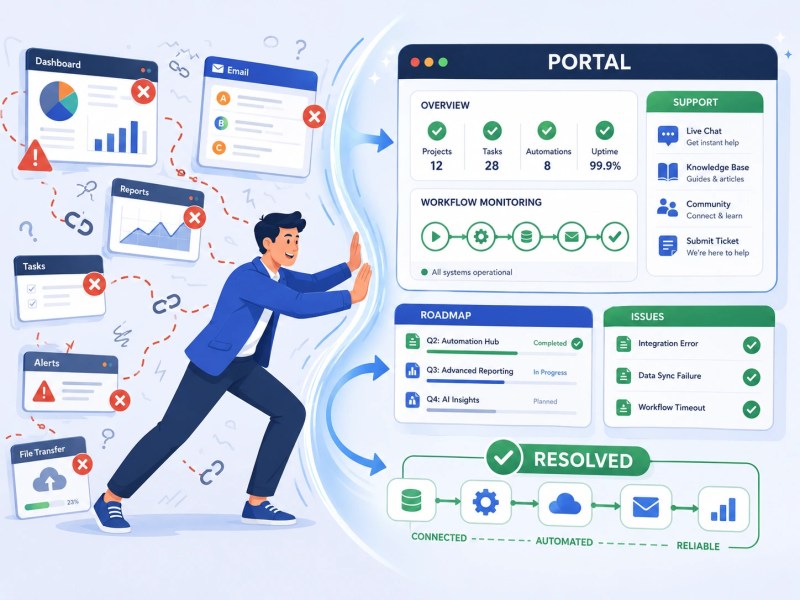
When partner resources are scattered across email threads, dashboards, and separate logins, delivery slows down. The partner portal consolidates referral dashboards, enablement content, marketing assets, and program updates in one place so account managers, automation builders, and business development contacts can work from the same source without friction.
The enablement content is the less visible but more durably useful part of the portal. According to Zapier, partners receive early insights into new features and roadmap updates, helping them anticipate platform changes and advise clients more effectively. For practitioners who need to guide clients on platform direction and capability, this advance visibility can translate directly into better consulting.
Consider a scenario that comes up regularly in client engagements: a client asks whether a specific app integration will support a certain trigger or action that it doesn’t currently have. Without partner-level insight into the product roadmap, the safest answer is “not yet.” With partner access, you can sometimes give a more useful answer — one that shapes how the client builds their process architecture around what’s actually coming, rather than locking them into a workaround that becomes obsolete in three months.
The operational difference is easier to understand when comparing fragmented resources with a centralized partner experience.
Tiers, Badges, and Co-Marketing: The Credibility Stack
The partner tier system starts at Certified Zapier Expert and scales upward based on a combination of certifications earned, client outcomes delivered, and platform activity. Higher tiers unlock expanded benefits — more prominent directory placement, co-marketing opportunities, and access to Zapier’s Solution Engineering and Marketing teams for 1:1 support on client engagements.
The tier badges function as trust signals, but their value is asymmetric. Within the Zapier ecosystem — where clients are already platform-aware — the Platinum badge communicates meaningful differentiation. Outside that ecosystem, the badge requires context to land. A client evaluating automation consultants who don’t know what Zapier is won’t interpret “Platinum Solution Partner” without an explanation of what the tier structure means and what it requires.
Co-marketing access is one of the more underused tier benefits. At higher tiers, partners can work directly with Zapier’s marketing team to develop content, case studies, or campaigns that carry Zapier’s brand alongside the partner’s. For agencies trying to reach mid-market or enterprise buyers, this Zapier brand association changes the conversation — it positions the partner as an implementation specialist within a recognized platform rather than an independent consultant making platform claims.
What Platinum Tier Actually Changes at the Operational Level
Most descriptions of partner tiers focus on the perks. What’s more useful to understand is what changes in day-to-day delivery work when operating at the Platinum level.
One of the most meaningful operational advantages available within Zapier’s broader partner ecosystem is access to dedicated technical support and Solutions Engineering resources. Zapier’s partner documentation highlights dedicated Solutions Engineering support for eligible partners, including technical troubleshooting and platform guidance. In a standard client engagement, when you hit an edge case — a Zap behaving unexpectedly under certain data conditions, an API trigger that doesn’t fire reliably at scale, or a workflow that behaves inconsistently under load — a more direct support channel can materially reduce resolution time.
A real example: a client running a high-volume lead routing workflow across their CRM and project management tool was hitting inconsistent behavior when lead volume spiked above their baseline. The issue wasn’t immediately reproducible in a test environment and involved task execution timing at scale. Resolving it cleanly required direct platform-level input — the kind of interaction that the standard support path isn’t optimized for. Partner-level access changes that resolution path. For more on how automation behaves differently at scale, see our breakdown of Zapier tasks vs Zaps — understanding that distinction matters when you’re designing for volume.
The other operational shift at Platinum is the visibility into referral performance and revenue tracking through the partner portal. For agencies managing multiple client accounts, being able to see which referrals are converting and at what plan level is useful data for practice planning — not just for commission tracking, but for understanding which client segments are generating the most platform adoption.
When These Benefits Matter — and When They Don’t
The benefits of the Solution Partner program are not uniformly valuable across all practice types. The framework below is a diagnostic, not a promotional summary.
Directory placement matters most when you’re building or early in your practice and don’t have an established inbound channel. If you’re already generating leads through content, referrals, or a strong industry reputation, the directory adds a secondary channel — useful, but not transformational.
The referral benefit matters most when a meaningful portion of your client work involves onboarding net-new Zapier users. If you primarily work with clients who are already on paid Zapier plans, this benefit is structurally limited for your specific practice.
Enablement and technical support matter most at scale. A solo consultant delivering simple, single-trigger Zaps for small businesses will rarely reach the edge cases where direct platform support changes an outcome. An agency delivering complex multi-system workflows for mid-market clients will hit those edges regularly — and the quality difference in resolution time and accuracy is meaningful.
Co-marketing and badge credibility matter most in enterprise or mid-market sales cycles where the client’s procurement process includes vendor vetting. In those contexts, Zapier’s brand association and partner certification serve as pre-qualification signals that reduce friction. In SMB sales, these signals often matter less than references and case studies. You can explore how we approach client-specific automation strategy through our guide to choosing a Zapier consultant — the criteria clients use to select partners tracks closely with where these program benefits actually move the needle.
The framework below summarizes which types of automation practices tend to extract the most value from the partner program.

Final Answer: The Zapier Solution Partner program delivers real operational value in three areas: directory placement as an inbound lead channel within Zapier’s ecosystem, a referral commission structure that adds revenue upside on net-new client onboarding, and tiered access to enablement, technical support, and platform-level engagement that improves delivery quality at scale. Badge credibility and co-marketing are real but context-dependent — they move the needle most in structured sales cycles where platform trust is a buying factor. If you’re regularly implementing Zapier inside client organizations and handling complex workflows through structured Zapier automation solutions, the program’s infrastructure compounds over time. If your work is primarily internal or involves simple, self-contained automations, the benefits are thinner. The program is most valuable to practitioners whose growth depends on expanding the Zapier ecosystem for clients — not just optimizing within it.
Need a reliable system?
Related Resources
Frequently Asked Questions
Is the Zapier Solution Partner program the same as the old Experts program?
It’s the rebranded and expanded successor. The core remains the same — it recognizes practitioners who implement Zapier for clients — but the new program adds a formal referral commission structure, a consolidated partner portal, and a revised tier system that factors in client outcomes alongside certifications. Existing Experts program participants transitioned automatically.
Do Solution Partner benefits apply to internal automation work, or only to client-facing implementations?
The program is explicitly designed for practitioners implementing Zapier on behalf of clients. Internal automation teams building workflows for their own organization don’t fit the program’s intent, and the referral benefit specifically requires referring net-new external customers to Zapier to generate commissions.
How does tier progression work in the new system?
Tiers are determined by a combination of factors including certifications earned, client outcomes delivered, and overall platform contribution. In practice, that means partners progress by pairing certification milestones with demonstrable implementation results rather than by team size alone. The 2025 system was designed to give all partner types equal opportunity to progress — not just those with the highest volume, but those demonstrating measurable client impact.
Can a solo consultant reach Platinum tier, or is it structured for agencies?
Solo consultants can reach Platinum tier. The program’s tier logic factors in delivery quality and client outcomes, not just team size or revenue volume. That said, Platinum-level benefits like dedicated technical support and co-marketing access are most practically useful to practitioners handling complex, high-volume, or multi-system engagements — which tends to correlate with more mature practices, solo or otherwise.
What happens to referral commissions if a client starts on a free plan?
The referral benefit includes clients who start on free plans and later upgrade to a paid tier, according to Zapier’s Solution Partner program documentation. This means the commission isn’t restricted to direct-to-paid conversions — it tracks the client’s eventual upgrade, which is relevant for practitioners onboarding clients who need to validate Zapier’s fit before committing to a subscription.
How does being a Solution Partner affect client trust in a sales conversation?
It depends on the client. Buyers already familiar with Zapier’s ecosystem — often in SMB or tech-adjacent businesses — recognize partner tiers and assign weight to them. Buyers in industries with less platform awareness need that context explained. In structured procurement or enterprise sales cycles, Zapier’s verification of a partner’s credentials serves as a third-party trust signal that reduces vetting friction. The badge matters most where the evaluation process is formal.
About the author

Miguel Carlos Arao is the Founder & CEO of Alltomate, a Zapier Certified Platinum Solution Partner focused on partner-tier automation delivery, including referral program strategy, client workflow systems, and multi-platform integration architecture. This article is based on hands-on automation design, workflow systems, and real-world implementation experience.

Built by a certified Zapier automation partner
Explore more at
our Zapier platform overview,
Zapier automation solutions, and
automation integration services.