
Follow-up sequences continue sending messages long after ownership changes, reply states desynchronize, or CRM stages stop reflecting real customer activity. A lead may already be in conversation with sales while automation still pushes outdated reminders because the sequence engine never received a valid suppression signal from the CRM or inbox provider.
This solution automates follow-up sequences across lead assignment, timed outreach, reply-aware suppression, escalation routing, and CRM synchronization while preventing duplicate outreach, stalled follow-up ownership, and disconnected engagement tracking. Teams coordinating downstream engagement-state consistency can also explore automated CRM synchronization updates.
If your current follow-up process still depends on manual reminders, inconsistent CRM updates, or disconnected email systems, explore CRM workflow automation services and cross-platform automation integration services before missed follow-ups begin degrading engagement visibility and response coordination consistency. Additional CRM coordination examples are covered in operational CRM automation examples.
System Snapshot
- Problem: Follow-up sequences lose synchronization when reply states, ownership changes, or CRM stages update inconsistently across systems.
- Core System: Automated lead follow-up orchestration with branching logic, suppression handling, escalation routing, and CRM synchronization.
- Key Risk if Missing: Leads receive duplicate outreach or remain untouched after sequence progression silently stalls.
- Primary Outcome: Faster follow-up continuity with cleaner ownership visibility and response-aware automation.
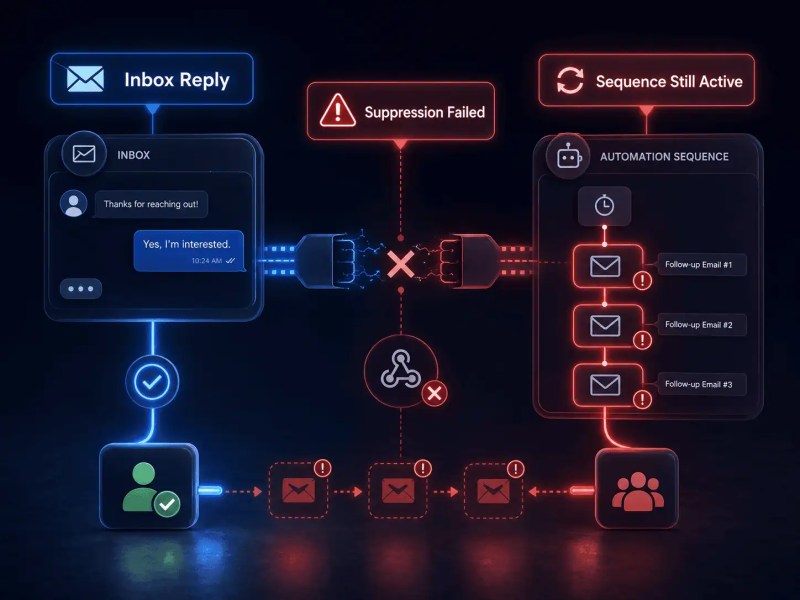
Reply-state desynchronization between inbox activity and CRM automation
This solution coordinates operational follow-up workflows where outreach timing, lead ownership, reply tracking, and CRM progression all depend on synchronized engagement signals. It becomes necessary when leads continue receiving follow-up emails after replying, reassigned contacts remain inside inactive sequences, or sales teams manually restart outreach because automation no longer reflects actual customer activity.
The system does not replace sales strategy or campaign planning, but it prevents disconnected reply tracking, stale CRM ownership, and inconsistent suppression logic from spreading follow-up delays across active sequences. Related systems like automated lead routing workflows and CRM lead assignment workflows extend follow-up coordination when ownership and response timing become operational dependencies.
Branching logic conflicts caused by duplicate contact ownership
One duplicate contact record can trigger parallel follow-up sequences simultaneously because ownership synchronization updates faster than suppression logic across CRM and email systems. When the same lead exists under two contact records with different owners, the sequence engine treats each record independently — enrolling both into separate outreach tracks without either branch aware the other is executing.
Manual intervention often makes the conflict worse because employees restart sequences after assuming the previous automation stalled permanently. The result is duplicated outreach history, inconsistent engagement tracking, and CRM stages that no longer reflect actual communication state.
The suppression layer resolves this by checking for existing active sequences, matching contact identifiers, and merging duplicate ownership records before enrollment completes. Without that pre-enrollment deduplication step, the branching conflict propagates silently across both records while reporting shows both sequences as healthy. Additional ownership-routing coordination patterns are covered in lead assignment coordination workflows and duplicate CRM lead reconciliation.
Follow-up sequence architecture across real engagement dependencies
The workflow separates lead intake, segmentation, sequence assignment, reply suppression, and CRM synchronization into isolated orchestration stages because outbound automation behaves unpredictably once inbox providers, CRM updates, and ownership reassignment all change independently. Validation occurs before sequence enrollment so incomplete lead records do not enter follow-up chains without routing ownership or suppression metadata.
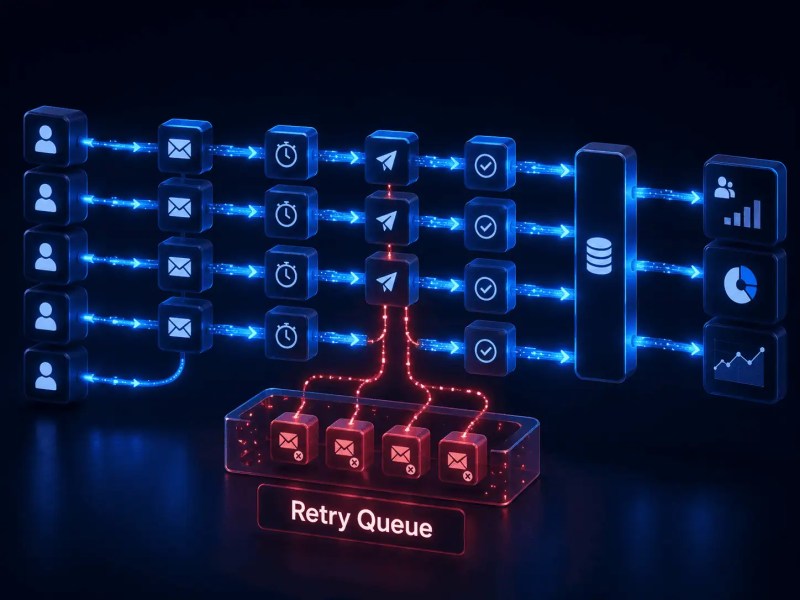
Reply detection, branch routing, email scheduling, and CRM synchronization operate independently through queue-based processing so one failed webhook or API timeout cannot freeze unrelated follow-up sequences behind it. Without queue isolation, stale suppression states and delayed CRM updates spread duplicate outreach across the entire pipeline.
- Lead Intake → CRM trigger → segmentation queue (missing ownership → escalation hold before enrollment)
- Sequence Assignment → outreach scheduling → suppression validation (duplicate contact → merge queue before duplicate outreach)
- Engagement Tracking → reply detection → branch routing (API timeout → retry queue before sequence desynchronization)
- Sequence State Sync → CRM update → reporting sync (failed suppression write → reconciliation queue before engagement-state drift)
The workflow architecture below shows how suppression validation, sequence branching, retry isolation, and CRM synchronization remain separated so one engagement failure does not corrupt unrelated follow-up progression.

Once follow-up progression depends on disconnected inbox activity and manual CRM updates, missed responses stop behaving like isolated sales issues and begin degrading reporting visibility, ownership coordination, and sequence continuity simultaneously. Explore CRM workflow automation services and AI-powered automation services before inconsistent follow-up behavior compounds across lead operations.
Escalation timing gaps that leave leads untouched after sequence completion
Follow-up systems require escalation governance because sequence completion does not guarantee a lead actually received timely human engagement. A sequence may technically finish while ownership reassignment, unanswered replies, or CRM stage stagnation leave the lead untouched operationally for days. Teams managing broader escalation governance and approval visibility can also explore automated escalation approval workflows.
Control Layer
- SLA timers monitor inactivity windows and escalate leads that complete outreach sequences without human follow-up ownership.
- Reply suppression validation prevents automation from continuing after inbox replies or CRM engagement updates occur asynchronously.
- Duplicate detection isolates parallel contact records before multiple follow-up branches execute simultaneously.
- Retry queues contain temporary API failures so delayed email providers or webhook interruptions do not freeze unrelated outreach.
- Audit logs attach suppression events, ownership changes, branch routing, and retry activity directly to workflow history because missing event-level tracing makes engagement failures impossible to reconstruct after escalation delays occur.
The escalation comparison below demonstrates how unmanaged follow-up timing leaves leads inactive after outreach completion while escalation-aware routing preserves ownership continuity.
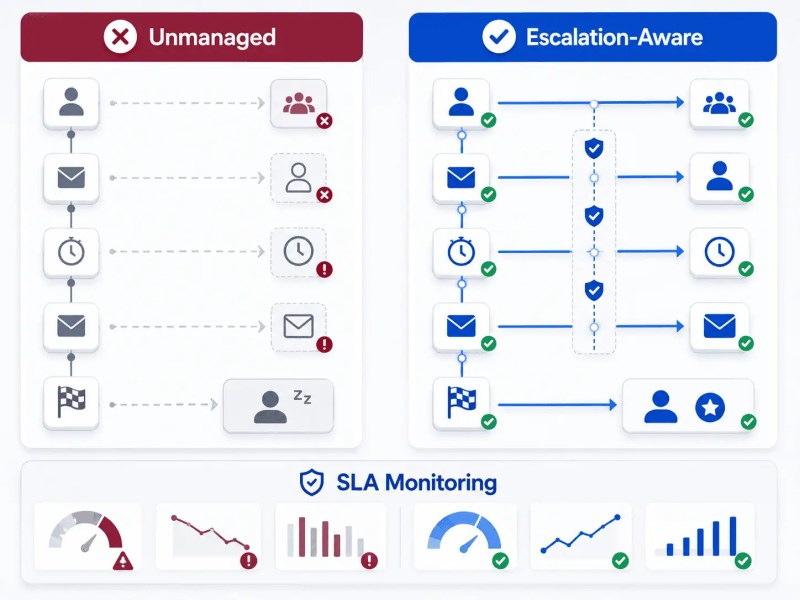
Without operational controls, automated follow-up accelerates inconsistent engagement instead of creating reliable response continuity because stale suppression states continue propagating across systems.
Operational sequence failure after reply detection stops updating
A lead replies directly to a follow-up email after business hours, but the inbox webhook fails during synchronization because the email provider temporarily rejects the callback request. The CRM never receives the suppression signal, so the sequence continues sending scheduled outreach overnight while sales assumes the automation already paused correctly.
By morning, the lead has received multiple unnecessary follow-up messages while the CRM still marks the conversation as inactive. The operational failure is not the email itself — it is the missing suppression acknowledgment before downstream automation continued executing.
Result: The webhook retry queue reattempts the suppression write when the email provider recovers, pauses the sequence before the next scheduled send executes, and logs the suppression gap with a timestamp so the sequence owner can see exactly when the reply occurred and when automation stopped — without needing to reconstruct the outreach history manually.
Retry queue isolation during outbound email API interruptions
Follow-up triggers write into validation queues before outreach scheduling occurs because CRM records often arrive with stale ownership data, missing suppression flags, or duplicate contact identifiers that would create conflicting outreach states if processed immediately. A direct trigger-to-sequence chain fails unpredictably here because one malformed engagement state can corrupt every downstream branch attached to the contact.
The validation layer checks ownership mapping, suppression history, reply state integrity, and CRM synchronization status before enrollment occurs so incomplete engagement records do not enter active sequences without operational visibility. Forwarding inconsistent lead states directly into automated outreach creates the exact failure where sequences appear healthy while downstream teams continue working from outdated customer activity.
Each synchronization queue maintains isolated retry handling so email providers, webhook callbacks, CRM updates, and reporting writes fail independently instead of freezing the entire follow-up operation during outbound API interruptions. Related systems like automated operational reporting and cross-team task handoff workflows help stabilize downstream visibility once follow-up ownership changes across operational teams.
The retry isolation model below demonstrates how failed email callbacks retry independently without blocking unrelated leads still moving through active outreach sequences.
When follow-up prioritization begins depending on AI-assisted engagement analysis, systems like AI-assisted email response workflows and AI-driven workflow orchestration can extend sequence branching without rebuilding orchestration logic. Additional operational AI patterns are covered in the AI Automation Guide and workflow orchestration platform comparisons.
CRM synchronization gaps and outbound platform constraints
CRM systems, outbound email platforms, and engagement providers rarely structure reply states or ownership metadata the same way, which creates synchronization gaps when sequence suppression depends on exact field mappings. A lead may appear “replied” inside the inbox provider while the CRM still marks the sequence as active because webhook payloads fail validation during synchronization.
API rate limits and delayed webhook delivery also create timing drift during high-volume outreach periods where reply detection, sequence branching, and CRM updates execute simultaneously. When all three execute within the same delivery window, rate limit queuing delays the suppression write long enough for the next scheduled outreach to fire before the CRM receives the reply state update. Related integration systems like cross-system data synchronization, automated API integration workflows, and cross-platform workflow orchestration help stabilize follow-up synchronization across operational systems.
Metrics that expose stalled follow-up progression before pipeline decay becomes visible
Operational reporting tracks suppression failures, duplicate outreach frequency, escalation timing, reply latency, and sequence abandonment because completed sends alone do not reveal whether leads are actually progressing through active engagement states.
Suppression failure rate is the most operationally significant metric because a rising suppression failure count means reply signals are not reaching the sequence engine reliably — which directly predicts duplicate outreach before it appears in lead complaints or pipeline reporting. Escalation timing gaps expose a different failure: leads that completed sequences without triggering human ownership, meaning the outreach executed correctly while the lead remained untouched afterward. Retry spikes inside webhook callbacks and suppression queues expose follow-up instability earlier than either of those signals because they appear at the infrastructure level before sequence-level failures become visible inside the pipeline.
Teams coordinating broader lead orchestration patterns can explore lead response time benchmarks and lead follow-up breakdown patterns for additional context.
Human review conditions inside automated follow-up orchestration
Human intervention remains necessary when reply intent becomes ambiguous, duplicate ownership conflicts require reconciliation, or escalation conditions involve high-value opportunities that automation cannot safely prioritize alone. Fully autonomous follow-up progression without review thresholds increases the risk of outreach continuing after active sales conversations already exist elsewhere.
Human review triggers activate at three conditions: reply content cannot be classified as positive, negative, or neutral engagement by the detection layer, ownership metadata conflicts between the CRM record and the sequence enrollment cannot be resolved automatically, and escalation conditions involve deal value thresholds or account flags that require manual prioritization before automation continues. Each condition routes the lead to a flagged review queue with the specific trigger and suppression history attached — not a generic hold — so the reviewer acts on a defined problem rather than reconstructing the entire outreach timeline.
If a flagged review item exceeds its inactivity window without a reviewer action, escalation fires to the sequence owner or team lead depending on deal context. Without that secondary escalation path, a flagged lead sits in review while downstream pipeline reporting continues treating the sequence as active and progressing normally.
Next steps and related resources
Teams expanding follow-up coordination across lead management and pipeline workflows can explore automated lead response workflows, lead follow-up workflow systems, CRM update automation, and automated deal tracking workflows.
Additional implementation guidance is covered in the Lead Management Automation Guide, CRM Automation Guide, response-time performance benchmarks, and lead follow-up breakdown patterns.
Frequently asked questions
Can follow-up sequences stop automatically after a lead replies?
Yes, reply-aware suppression logic can pause or reroute sequences after inbox activity or CRM engagement updates are validated. Without suppression handling, automation can continue sending outreach after active conversations already started.
What happens when CRM updates fail during follow-up automation?
Retry queues isolate temporary synchronization failures so delayed CRM updates do not freeze unrelated outreach sequences. Without retry isolation, stale ownership and suppression states can spread duplicate follow-up activity across the pipeline.
Can automated follow-up sequences support branching logic?
Yes, workflows can branch based on replies, inactivity windows, CRM stages, or engagement behavior after validation completes. Without controlled branching logic, leads can enter conflicting sequences simultaneously.
Do follow-up workflows still require human review?
Yes, escalation conditions, ambiguous replies, and duplicate ownership conflicts often require operational review before automation continues. Removing review thresholds entirely increases the risk of incorrect outreach progression.
Why do follow-up sequences require escalation controls?
Escalation monitoring exposes leads that complete outreach without receiving active human ownership afterward. Without escalation handling, sequences can finish successfully while leads remain operationally untouched.
Why Alltomate
Alltomate designs follow-up automation systems around synchronization drift, suppression failures, duplicate ownership conflicts, and delayed engagement visibility because operational follow-up workflows rarely fail in clean or predictable ways. Instead of treating follow-up sequences as simple timed emails, the architecture models how inbox providers, CRM states, reply handling, and escalation timing interact under real operational constraints.
If your current follow-up process depends on manual reminders, disconnected CRM stages, or inconsistent suppression logic between platforms, explore CRM Automation Services, Automation Integration Services, and AI-Powered Automation Services before stalled engagement states begin degrading sequence continuity and response coordination.
About the solution designer

Miguel Carlos Arao is the Founder of Alltomate and a Zapier Certified Platinum Solution Partner specializing in automation systems, workflow architecture, and real-world implementation.

Built by a certified Zapier automation partner
Explore
operational automation services,
workflow orchestration systems,
read the workflow operations blog,
or reference the process automation guides.