
Published on July 27, 2026
For a deeper look at what Zapier can actually do before you hire anyone, see our Zapier automation services for businesses. If you’re evaluating automation beyond Zapier alone, our business automation consulting services explains how we design broader workflow systems. If you’re not yet sure where your automation is breaking, start with our free business process audit.
Quick Answer: There’s no single “best” Zapier agency — the right one depends on which tier your problem actually sits in. Freelancers handle single-Zap fixes, boutique shops handle multi-step workflows for one team, full-service agencies handle broader systems but vary wildly in reliability practices, and Zapier Certified Platinum Partners are vetted specifically on task volume, support response, and build quality. Match the tier to your problem before you match a name to a search result.
Table of Contents
- Why “Best” Depends on What Tier of Agency You Actually Need
- Where Freelance Zapier Help Breaks Down
- What a Boutique Automation Shop Gets Right — and Where It Hits a Ceiling
- Full-Service Agencies vs. Certified Partners: The Line That Actually Matters
- What Certified Partner Work Actually Looks Like
- Pricing Models: Project-Based vs. Retainer
- How to Narrow It Down From Here
Most “best Zapier agency” lists read like they were written by someone who’s never had to fix a Zap at 11pm because a client’s lead routing silently stopped working three days ago. The truth is messier than a ranked list: “Zapier agency” isn’t a regulated category, and the businesses that call themselves one range from a single freelancer with a Zapier badge on their LinkedIn to firms that have gone through Zapier’s actual partner vetting process. Before you can find the best one, you need to know which tier your problem belongs in — because the tiers aren’t just a quality gradient, they’re built for genuinely different jobs. For context on what Zapier itself can and can’t do before you bring in outside help, our complete Zapier guide covers the platform fundamentals this post assumes you already understand — start with what Zapier is and how it works if you need the basics first.
Why “Best” Depends on What Tier of Agency You Actually Need
The assumption baked into most “best of” searches is that agencies differ mainly in skill — some are better at Zapier, some are worse, rank them and pick the top one. That’s not actually the axis that matters most. The bigger difference is what each tier is built to handle at all. A single-Zap fix and a multi-tool, multi-step workflow with error handling and fallback logic aren’t the same job scaled up — they’re different jobs, and an agency optimized for one is often a poor fit for the other, regardless of how skilled the individual doing the work is.
This is why “best Zapier agency” searches so often lead to disappointment: the searcher hires the highest-rated result without checking whether that agency’s typical engagement matches their actual complexity. A five-star freelancer who’s excellent at connecting Gmail to a spreadsheet isn’t necessarily equipped to build conditional routing across three CRMs with error alerts — not because they lack skill, but because that’s a structurally different kind of build.
Where Freelance Zapier Help Breaks Down
Freelance Zapier help is usually the right call for exactly one thing: a single automation, built once, that doesn’t need to survive contact with edge cases. Think “when a form is submitted, add a row to a spreadsheet and send a Slack message.” If you’re looking for more practical scenarios, see our collection of real-world Zapier workflow examples. If you’re still learning Zapier terminology, our Zapier Tasks vs. Zaps explained explains the difference. That’s a real job, freelancers do it well, and paying agency rates for it is overkill.
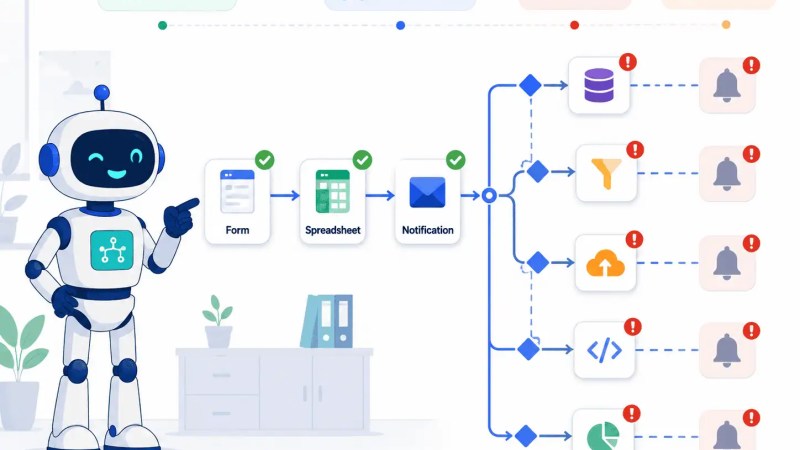
The breakdown happens when that one Zap becomes three, and the three need to talk to each other, and one of them needs to behave differently depending on a field value from a CRM that updates asynchronously, using branching logic like Zapier Paths. At that point, the failure mode shifts — a freelancer working project-to-project often doesn’t build in error handling, retry logic, or monitoring, because a single client’s single Zap doesn’t usually justify that overhead. A consistent pattern we see in this setup: the Zap works perfectly in testing, runs fine for weeks, and then fails silently the first time an upstream app changes its field structure — and nobody notices until a lead has gone unrouted for four days.
The progression below illustrates why a workflow that starts as a simple automation eventually becomes a connected system where failures in one step can affect everything downstream.
What a Boutique Automation Shop Gets Right — and Where It Hits a Ceiling
Boutique shops — typically two to ten people, often specializing in one or two platforms — are the right fit once you’re past single-Zap territory but still operating as one team with one set of tools. They tend to bring process discipline a solo freelancer doesn’t: documented workflows, some testing before launch, a defined handoff. For a small business automating its own sales pipeline or internal ops, this tier is often genuinely the best fit, not a compromise.
The ceiling shows up at scale and at cross-tool complexity. When a workflow needs to span five or six connected apps, handle high task volume without hitting Zapier’s rate limits, or maintain uptime standards a client’s revenue actually depends on, boutique shops without dedicated reliability practices — monitoring, alerting, documented rollback plans — start to show the same silent-failure pattern as freelancers, just at a larger and more expensive scale. Zapier documents its own platform limits and explains that high-volume workflows can encounter throttling and execution limits, making workflow architecture increasingly important as automation volume grows (Zapier Help Center – Zap limits). The tell isn’t skill; it’s whether “what happens when this breaks” was designed for, or discovered the hard way. Our Zapier troubleshooting guide for automation failures covers many of the issues that appear once workflows become production-critical.
The failure pattern described above becomes much easier to understand when you see how workflow complexity expands beyond what a small team can comfortably monitor.

Full-Service Agencies vs. Certified Partners: The Line That Actually Matters
“Full-service automation agency” is the vaguest label in this space, because it describes scope, not capability. A full-service agency might build in Zapier, Make, n8n, and custom code across marketing, operations, and finance — which is genuinely valuable if your automation needs actually span that range. If your goal is improving business operations rather than simply connecting apps, our Zapier for business automation guide explains the types of systems businesses typically automate before deciding whether they need an agency. But scope and reliability aren’t the same axis. A pattern we see consistently across client engagements: the agencies that call themselves “full-service” are often optimizing for breadth of what they’ll take on, not for what happens when a specific step silently fails inside a specific client’s workflow.
Zapier Certified Solution Partners — and Platinum-tier partners specifically — sit on a different axis entirely, because that status isn’t self-declared. It’s granted through Zapier’s official Solution Partner Program, a formal application and tiered qualification process (Zapier Solution Partner Program). Zapier doesn’t publicly disclose every evaluation criterion, but the designation is externally awarded rather than self-assigned — which doesn’t make every certified partner automatically better than every full-service agency at every task, only that the label reflects a defined program’s standards rather than an agency’s own marketing. Zapier’s partner tiers run Silver, Gold, and Platinum Solution Partner, with Platinum reserved for partners who’ve completed Zapier’s highest training requirements and support the largest, most complex implementations (Zapier Partner Program). For businesses where a workflow failure has real revenue or compliance consequences, that distinction is usually worth the higher rate. Alltomate’s own Zapier automation solutions is built to that standard — designed around what happens when something breaks, not just what happens when the demo works.
The distinction isn’t simply about who can connect more software. It’s the difference between broad implementation capability and systems intentionally designed for long-term operational reliability.

What Certified Partner Work Actually Looks Like
It’s easy to describe reliability abstractly and harder to show it. In implementations we’ve built for field service and professional service businesses, the failure point is almost never the Zap itself — it’s the handoff between systems that were never designed to talk to each other. A field service company connecting Jobber Zapier integration case study is a useful example: the automation isn’t just “trigger an action when a job is created,” it’s making sure dispatch, invoicing, and customer follow-up stay in sync even when a job gets rescheduled or a field changes mid-process. That’s the kind of build where the difference between a working demo and a system that survives six months of real use becomes obvious fast.
This is also where the honest caveat belongs: Platinum-tier partner work is genuinely overkill for a solo founder running three simple, low-stakes Zaps. That business doesn’t need vetted reliability practices or support SLAs — it needs a working automation at a fair price, and a freelancer or boutique shop will serve it better and cheaper. If you’re wondering what kinds of business processes are commonly automated before reaching that level of complexity, see our business Zapier automation examples. Certified partner work earns its cost when the automation is load-bearing for the business, not before.
Production automation isn’t judged by whether it worked during launch—it is judged by how well it continues operating as systems, data, and business processes change over time.

Pricing Models: Project-Based vs. Retainer
Pricing tends to track tier fairly closely. Freelancers, boutique automation shops, full-service agencies, and certified partners generally scale their pricing based on workflow complexity, implementation scope, and whether ongoing support is included. Project-based engagements usually involve a fixed scope and fixed price, while longer-term support is commonly structured as a recurring retainer. For what those numbers actually look like across tiers, see our Zapier pricing breakdown. That’s fine when the workflow is static and unlikely to need ongoing adjustment.
Full-service agencies and certified partners more often work on retainer, especially for multi-step or multi-tool systems, because the real cost of automation isn’t just the build — it’s what happens when an app updates its API, a business process changes, or a step starts failing intermittently under higher volume. A project-based engagement typically has no mechanism for catching that; a retainer does. Neither model is objectively better — a retainer is wasted spend on a workflow that genuinely never changes, and project-based pricing is a false economy on a system where failure has real cost.
The pricing models below reflect two different operating philosophies: delivering a completed implementation versus continuously maintaining a business-critical automation system.

How to Narrow It Down From Here
Once you know roughly which tier fits your situation, the next step is evaluating specific agencies within that tier — checking certification level, actual portfolio depth versus claimed experience, and how they talk about what happens when something breaks. We’ve laid out that full evaluation process separately in how to choose the right Zapier consultant, since it deserves more space than a section here can give it.
Final Answer: The best Zapier agency isn’t a single name — it’s whichever tier matches your workflow’s actual complexity and failure cost. Simple, static automations are well served by freelancers or boutique shops, while complex, cross-tool, revenue-critical workflows are better served by full-service agencies or Zapier Certified Platinum Partners, where reliability practices and vetted standards — not just scope — are part of what you’re paying for. If you’re not sure which type of Zapier partner is right for your business, book a free automation strategy call before you commit to an agency.
Not sure which type of Zapier agency you actually need?
Related Resources
FAQs
How much does a Zapier agency cost?
It depends heavily on the scope of work. Pricing typically increases with workflow complexity, the number of connected systems, implementation effort, and whether ongoing monitoring, maintenance, and support are included after launch.
Do I need a Zapier expert, or can I build this myself?
If the automation is a single, low-stakes step, DIY is usually fine. Once a workflow spans multiple apps, needs conditional logic, or would cause real problems if it failed silently, outside expertise starts paying for itself in avoided downtime and rework.
What’s the difference between a Zapier Certified Partner and a regular automation agency?
Certification is granted by Zapier based on criteria like task volume managed, build quality, and support responsiveness — it’s third-party validated rather than self-described. A non-certified agency can still be skilled, but that skill hasn’t been externally vetted against a defined standard.
Should I hire a Zapier agency or a Make.com agency instead?
That depends on which platform actually fits your tool stack and workflow logic — the two aren’t interchangeable in every case. If you’re weighing this specifically, our Zapier vs. Make comparison guide breaks down where each platform tends to fit better.
Can a Zapier agency also work with tools like HubSpot or Apollo.io?
Most experienced Zapier agencies build across the CRMs and sales tools their clients already use — Zapier’s role is connecting those tools, not replacing them. Ask any agency you’re evaluating for specific examples with your particular stack rather than assuming general Zapier experience covers it.
About the author

Miguel Carlos Arao is the Founder & CEO of Alltomate,
a Zapier Certified Platinum Solution Partner focused on Zapier agency evaluation, including certification-tier differences, reliability engineering practices, and post-launch support models.
The patterns in this article come directly from building and troubleshooting Zapier automation systems across client engagements in field service and professional services.

Built by a certified Zapier automation partner
Explore more at
Zapier platform hub,
Zapier automation services, and
custom Zapier automation solutions.